Select a site alphabetically from the choices shown in the box below. Alternatively, browse sculptural examples using the Forward/Back buttons.
Chapters for this volume, along with copies of original in-text images, are available here.


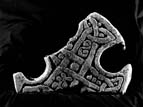
Object type: Part of cross-head [1]
Measurements: H. 31.5 cm (12.4 in); W. 40 cm (15.7 in); D. 12 cm (4.7 in)
Stone type: As Kirkby Wharfe (St John the Baptist) 1
Plate numbers in printed volume: Ills. 432-5
Corpus volume reference: Vol 8 p. 188
(There may be more views or larger images available for this item. Click on the thumbnail image to view.)
A cross-head of type E9/10, edged by flat mouldings. The style of carving is similar to Kirkby Wharfe 1.
A (broad): The strands which cross at right angles, as on face A of Kirkby Wharfe 1, here enclose a large pellet at the centre, but frame at each side smaller pellets (three on the complete arm), a small scroll above, and a flower with at least five petals below. In the upper arm the strands develop into a terminal Stafford Knot (simple pattern E), and part of another can be seen in the incomplete right arm.
B (narrow): Dressed plain, without mouldings.
C (broad): This face has some elements in common with face C of Kirkby Wharfe 1. Strands emerge from each arm and cross through a loose ring to extend into the adjacent arms. The terminals are different however. In the upper arm a potentially simple bar-terminal crosses and turns inwards to form two spiral curls. In the left arm the edging strands turn back to form curls before meeting, that from the upper corner encloses a pellet. The treatment of the centre is also different. Six pellets, four of them joined in pairs by curving and crossing lines, roughly cover rather than circle the centre. This may also be a reminiscence of interlinked tendrils in medallion scrolls such as that at the top of Ilkley 1B and D.
D (narrow): Missing
The decoration of this head links it closely with that of Kirkby Wharfe 1 and its parallels, Aberford 3, Collingham 5, and Saxton 1 (see Chap. V, p. 49). The plant details suggest that the origins of this interlace type owe as much to plant-scroll as to abstract interlace. See also Kirkby Wharfe 2.
