Select a site alphabetically from the choices shown in the box below. Alternatively, browse sculptural examples using the Forward/Back buttons.
Chapters for this volume, along with copies of original in-text images, are available here.


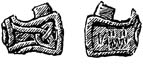
Object type: Cross-arm [1]
Measurements: (after Collingwood 1915a) L. 16.5 cm (6.5 in); W. and D. Not recorded
Stone type: 'Whitish freestone' (ibid.)
Plate numbers in printed volume: Ills. 430-1
Corpus volume reference: Vol 8 p. 188-9
(There may be more views or larger images available for this item. Click on the thumbnail image to view.)
This appears to be one arm of a cross-head of type E10, but it is not free-armed like Kirkby Wharfe 1 and 3, but is a ring-head of type a. It is edged by flat mouldings on both faces.
A (broad): It looks probable from the drawing that the strands in the surviving arm represent the same type of right-angled crossing framing the centre as on face A of Kirkby Wharfe 1 and 3. The strands certainly terminate in a Stafford Knot (simple pattern E).
B and D (narrow): Not drawn by Collingwood.
C (broad): Collingwood (ibid., 207) said 'the marks, almost like lettering' were probably meant to deface the actual ornament: they look like keying for plaster.
This fragment shows a direct influence from Scandinavian monument types in the form of the head. It is similar to the type found at Gargrave (nos. 6 and 7, Ills. 292–5, 296–7), but even simpler in its decoration. If the crossing of the interlace strands is as on the free-armed heads at this site, the case for Scandinavian influence in the development of this pattern is considerably strengthened (Chap. V, p. 49).
