Select a site alphabetically from the choices shown in the box below. Alternatively, browse sculptural examples using the Forward/Back buttons.
Chapters for this volume, along with copies of original in-text images, are available here.


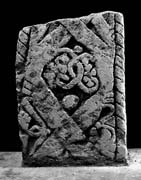
Object type: Part of cross-shaft [1]
Measurements: H. 38 cm (15 in); W. 26.5 > 25.5 cm (10.4 > 10 in); D. 13.5 > 12.7 cm (5.3 > 5 in)
Stone type: As Kirkby Wharfe (St John the Baptist) 1
Plate numbers in printed volume: Ills. 436-9
Corpus volume reference: Vol 8 p. 187-8
(There may be more views or larger images available for this item. Click on the thumbnail image to view.)
A cross-shaft of rectangular section, the arrises edged with cable moulding.
A (broad): An angular, lattice-like medallion scroll, of which only one medallion survives, with broad flat stems. Fine tendrils spring from each stem to link in the centre of the medallion and terminate in a many-petalled flower. Single loose pellets fill the spaces above and below the tendrils. Similar tendrils fill the spandrels between this medallion and the incomplete one below: curving and flowery on the right, more angular and leaf-like on the left. The spandrels above the medallion are less clear, but that on the right may have a downward-pointing pointed leaf.
B (narrow): A continuous large-scale double-stranded meander of type 2, of which one and a half elements survive.
C (broad): An eight-cord basket plait, median incised.
D (narrow): Only a fragment at the top of this face survives. It seems to show a single strand pattern, but it is not clear whether this would be a step pattern or meander.
This type of scroll which crosses and re-crosses lattice-like along the length of a shaft is found elsewhere in Wharfedale. In general, it is an example of a long-lasting tradition which appeared first at Otley (Ills. 561–3) and was thereafter reproduced in line with changing styles until the end of the period (see for example Ilkley 1B and 1D (Ills. 336, 338) for a transitional form), but there are complex inter-relationships among the various examples (Chap. V, p. 53). This angular example links so closely with one from Collingham, no. 3 (Ill. 153), which has a similar approach to design on all four faces, that it seems probable they are the work of one sculptor.
