Select a site alphabetically from the choices shown in the box below. Alternatively, browse sculptural examples using the Forward/Back buttons.
Chapters for this volume, along with copies of original in-text images, are available here.


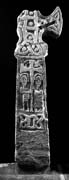
Object type: Cross-shaft and part of -head, in four fragments now joined [1]
Measurements: H. 123 cm (48.4 in); W. 24.9 cm (9.7 in) (below panel with cross) > 19.5 cm (7.7 in) at top of shaft, 30.8 cm (12.1 in) across centre of incomplete head; D. 12 > 11 cm (4.8 > 4.3 in)
Stone type: Fine grained dolomitic limestone with a cellular structure. Colour light grey (10YR 7/2). Very local, quarried within 0.5km of the church. Brotherton Formation (Upper Magnesian Limestone), Upper Permian. [J.S.]
Plate numbers in printed volume: Ills. 440-3
Corpus volume reference: Vol 8 p. 185-7
(There may be more views or larger images available for this item. Click on the thumbnail image to view.)
A tapering cross-shaft of rectangular section, with a head of type E10/11. The broad faces of the head and all faces of the shaft are outlined with plain flat mouldings. The carving is crisp and sharp-edged, without modelling. The lowest quarter of the cross-shaft on all faces is dressed plain.
A (broad): (i) At the centre of the cross-head are four strands, two horizontal and two vertical, which cross at right angles, framing between them five pellets, including one in the centre. These strands extend into the arms of the cross. No arm survives complete, but the end of one arm has been restored to a credible position on the right, where the termination of an interlace knot formed from two strands can be seen. In the lower arm one of the strands bifurcates to enclose a pellet, and both strands continue to terminate in a Stafford Knot (simple pattern E) which fills the end of the arm. Every space formed by this knot encloses a loose pellet. (ii) The main body of the shaft below is filled by a tall cross on a narrow stem. The head of the cross, of type B9/10, has a tri-lobed leaf growing from each of its side arms, to fill the upper spandrels. Below the cross, on the right, a figure in a long robe stands three-quarter-turned to the cross, its head frontal with drilled features and framed at the top and sides by flat hair or halo. On the left is a comparable figure with a shorter tunic. Both hold on to and reach out to touch the shaft of the cross with their one visible arm. The shaft is broken below this, destroying any trace of a panel divider. (iii) Below the break is a pair of large-scale, outward-facing Stafford Knots (simple pattern E), linked by a short glide.
B (narrow): The side of the cross-head is dressed plain, without mouldings. The shaft has five complete and two incomplete elements of step pattern 1, simply incised.
C (broad): (i) The central pellet on the cross-head is framed in the overlap of two linked elongated ovals. Below this, two strands emerging from the end of the lower arm, which is damaged, cross below the centre, where they lace through a loose ring, then, following the curve of the armpits, extend into the arms on either side. Similar strands emerge from these arms and apparently extend into the missing upper arm. The strands on the left converge to form a terminal Stafford Knot (simple pattern E). (ii) Below the border for the head is a narrow horizontal panel of fine plait work. (iii) On the shaft is a six-cord basket plait with included terminals at the top, made to fit by being drawn more loosely as the panel widens downwards.
D (narrow): This side of the head is missing. The decorated area of the shaft contains three and a half elements of meander type 2. This is in the grooved technique of faces A and C, not incised as on face B.
The scene on face A occupies a major part of one broad face of a relatively small shaft, on which the lower third of the shaft is completely plain on all sides. This scene has to be considered alongside others in which a long-stemmed cross without a figure of Christ is accompanied by a male and female figure, one on each side. There are two in northern England, one from Burton in Kendal, Westmorland (Bailey and Cramp 1988, 82–3, no. 1, ills. 180–3), the other from Halton, Lancashire (Collingwood 1927, 159–62, fig. 191; see Ill. 869). These are very different in style and technique, and in some details: for example the Burton in Kendal and Halton scenes clearly have staff crosses with relatively small heads; while that at Kirkby Wharfe not only has a full-sized head but one which is flowering, a clear reference to the symbolism of the tree. However, in all cases the figures beneath have been identified as Mary and John attendant at the Crucifixion; and all are tenth century or later. This reduced but still narrative type of the Crucifixion refers to the moment in the Gospel of St John when Christ commits his mother to John's care and John to his mother as her son (John 19, 26–7). John is also present as an eye-witness to the event. One part of the meaning of the scene, therefore, is a statement of the historicity of the Crucifixion event, while the reference to one of the sayings of Christ on the cross could also have been a focus for devotion. The reduction of the scene to include only John and Mary is relatively rare in Northumbrian sculpture of the pre-Conquest period: this in itself might suggest a new interest in the significance of their presence and possibly new sources of influence.
The flowering tree at Kirkby Wharfe also suggests a parallel with Tree of the Knowledge of Good and Evil from the Genesis story of Adam and Eve: the parallel here is between Christ and Mary, and Adam and Eve, and the theme is Redemption necessitated by the Fall. These ideas appear in sermons of the time quite explicitly, for example in one of the Blickling Homilies for the Feast of the Annunciation (Morris 1880, 1–13; Coatsworth 1979, I, 38–9), and are also illustrated in ivories and manuscripts of the tenth and eleventh centuries (Schiller 1972, pls. 373, 381, 387). Depictions of Adam and Eve beneath the tree, with either Eve tempting Adam or both trying to cover their nakedness, might have been well known, though in sculpture such scenes are better attested in Ireland than in England (see Harbison 1992, III, figs. 652, 654–5, 658, 660, 663–6, for example). There are probable examples on Barwick in Elmet 2 and Bilton in Ainsty 4, however (see Ills. 30, 31, and Chap. VI, p. 60). In Anglo-Saxon sculpture a scene of Eve tempting Adam also appears on a cross-shaft from Newent in Gloucestershire, where the notion of Redemption is made explicit by the presence of a cross 'growing' on one of the branches of the tree (Kendrick 1938, pl. LXXVII.1). Other potential sculptural references to Adam and Eve are more doubtful, although a possible example on face C of Urswick 1, north Lancashire, is balanced by two figures facing each other with a staff cross between them on face A, which, with due allowance for the difficulty of identifying such scenes, could perhaps be a balancing of an image of the Redemption on one face against an image of the Fall on the other (Bailey and Cramp 1988, 148–51, ills. 565, 568; but see also Addingham 1 in this volume, p. 90). At Burton in Kendal 1, Westmorland, the scene with John and Mary on either side of the cross sits above a scene in which Christ in Majesty tramples a serpent (ibid., 82, ill. 180): a different combination but a similar message. Indeed, this is not the end of the possible connotations, for at Hornby, Lancashire, a flowering tree stands above a rendering of the loaves and fishes from the Feeding of the Five Thousand. Bailey (1996c, 26–8, pl. 2) suggests this scene is a 'foreshadowing' or 'type' of the Last Supper and the Eucharist, linking the fruiting vine with the bread of Heaven and with Christ as the Bread of Life: a comparison made already in John 6.
In layout, the Kirkby Wharfe cross appears to stand in the tradition of the Northumbrian panelled cross, though in a very reduced form (and it is interesting that the two parallels pointed to above also stand in this tradition). It may also be relevant that both parallels are in the north-west, as the outstanding feature of Kirkby Wharfe 1, apart from its iconography, is the striking similarity of the style and layout of the interlace in the cross-head to examples from Aberford 3, Collingham 5, and Saxton 1 (Ills. 11, 164, 688), a local group with possible Manx Viking connections. The heads at Kirkby Wharfe (nos. 1 and 3) are the most nearly complete examples of this group, in which the interlace crosses from arm to opposite arm, rather than arm to adjacent arm. However, influence from Anglian modes of decoration, as on the cross-head Ilkley 8 (Ill. 373), might still be seen even in this angular design, while also allowing influence from the Manx pattern, in the period of specifically Norse-Irish ascendancy (see Chap. V, p. 49).
