Select a site alphabetically from the choices shown in the box below. Alternatively, browse sculptural examples using the Forward/Back buttons.
Chapters for this volume, along with copies of original in-text images, are available here.


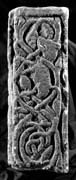
Object type: Part of cross-shaft [1]
Measurements: H. 77.5 cm (30.5 in); W. 29.8 > 28 cm (11.7 > 11 in); D. 18 > 14 cm (7.1 > 5.5 in)
Stone type: As Ilkley (All Saints) 4b (p. 172) but also contains some muscovite mica flakes. [J.S.]
Plate numbers in printed volume: Ills. 383-6
Corpus volume reference: Vol 8 p. 175
(There may be more views or larger images available for this item. Click on the thumbnail image to view.)
The edge mouldings are flat and plain. The surviving broad face shows minimal taper (contra Collingwood 1915a, 195, fig. n).
A (broad): A continuous medallion scroll which certainly in its lower reaches has lost all plant-like vestiges: there are only vestigial leaves or buds (two strands end in spear-shaped leaves — there is a detached-looking tri-lobed bunch in one spandrel), and the effect is of purely abstract interlace. The upper end, however, finishes with two crossing strands in a heart-shaped medallion, and these terminate in grape bunches; there are pointed leaves in the spandrels between the two upper medallions, and buds in the upper corners of the shaft. (This top medallion is somewhat reminiscent of the medallion scrolls at the top of Ilkley 1, faces B and D.)
Standing in the central medallion with its head reaching into the upper medallion is a large animal, a quadruped with a doglike head, which reaches up to bite at one of the berry bunches. The animal's legs straddle and interlace with the scroll's fleshy stem. Its short tail meets with a thickened terminal of the lower interlacing in the spandrel between the lower and central medallions. It is very close to being an animal involved in interlace rather than a free animal in a scroll. There are two places, at least, where the background has not been cut away cleanly, adding to the difficulty of interpretation. The plain flat border survives at the top and on both sides.
B (narrow): A tangled continuous scroll of which four volutes survive: the lowest is very worn. A heart-shaped leaf and a triangular berry bunch drop from the volute above, which ends in a tri-lobed leaf-flower. A paired leaf with a bud fills the spandrel at the centre left. A long-necked bird with its head turned right, with wing and tail, is involved in the two upper volutes, as clumsily as the animal on face A. The border survives at the top and on the left.
C (broad): Missing. Worn or worked completely smooth.
D (narrow): A fleshy spiral scroll of which parts of four volutes survive. The two lowest seem to end in a round berry bunch or a formal flower, the third above has a drop leaf, its terminal is not clear. Paired leaves with buds emerge from the swollen bindings.
The plant-scrolls on this shaft represents a late stage in the development of pre-Viking sculpture, in which the animals are beginning to predominate (see Chap. V, pp. 53, 56). Although heavy and clumsy in execution, its predecessors include Otley 1B (Ills. 561– 3), of which there may have been more followers at Ilkley, where ornament much closer in concept and execution can be seen on the cross-head Ilkley 8 (below).
