Select a site alphabetically from the choices shown in the box below. Alternatively, browse sculptural examples using the Forward/Back buttons.
Chapters for this volume, along with copies of original in-text images, are available here.


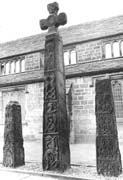
Object type: Incomplete cross-head in two pieces [1]
Measurements: H. 52 cm (20.5 in); W. 61 cm (24 in); D. 21.5 > 14 cm (8.5 > 5.5 in)
Stone type: Medium grained well-sorted sandstone with sub-angular grains. Colour very pale brown (10YR 7/3). Not the same provenance as Ilkley (All Saints) 1, although this could be one of the sandstone units (i.e. Nesfield Sandstone) locally associated with the Millstone Grit units, Namurian, Upper Carboniferous. [J.S.]
Plate numbers in printed volume: Ills. 334, 343, 365-8, 373-4; Fig. 14g
Corpus volume reference: Vol 8 p. 176-7
(There may be more views or larger images available for this item. Click on the thumbnail image to view.)
A cross-head in two fragments, type A9. Although found separately at different times, they fit together convincingly in spite of the slight gap, an impression reinforced by considerations of iconography and style. Both broad faces are edged with mouldings, probably squared but very worn.
A (broad): The central boss is not raised and is surrounded by a triple roll moulding. The upper arm has a battered figure, with wings and a nimbus, and unidentifiable features in the spaces above his shoulders. The side arms have birds perched in vestigial plant-scroll, biting at berry bunches. The bird in the left arm has a backward-turned head.
B (narrow): The sides of the arms are plain but with edge mouldings on the ends of the upper and side arms, in the curve of the armpit, and on the bottom of the side arm.
C (broad): A plain central boss with a single raised moulding. The left side arm has a bird facing left with a long double-outlined wing, and with its downward pecking head in the bottom left corner, just in front of its three-toed foot. It perches among narrow lacing strands with no vestige of leaf or berry bunch, which extend above and below the central roundel and enter the right arm, which is now completely worn smooth. These strands cross with independent strands from the lower, missing arm and from the upper arm, which also pass on either side of the central roundel. In the upper arm the strands cross, and that on the right develops into a spiral, while the other becomes a diagonal through the spiral. The end of the spiral and the diagonal terminate with a nod to the plant form in the upper corners of the arm, and there is also a drop leaf from the left of the spiral.
D (narrow): This face must originally have been like B but is now worn completely smooth.
F (bottom): The mouldings framing plain panels have survived underneath the arm to the right of face A; although the other side is more worn, the edge mouldings can still be seen.
An interesting aspect of this head is the use of strands crossing from arm to opposite arm instead of spreading from arm to adjoining arm. The use of the 'right-angled crossing' is seen as characteristic of Manx sculpture, and to have been brought into west Yorkshire — where it appears on Aberford 3, Collingham 5, Kirkby Wharfe 1 and 3, and Saxton 1 — by Norse-Irish invaders who also occupied the Isle of Man (Bailey 1980, 219; and see Chap. V, p. 49). Its presence here however could suggest that the Norse settlers were influenced by an existing Anglian iconography which they adapted to their own style.
On the bird in the inhabited plant-scroll with its down-bent head, there are clear signs of influence from a similar bird in the scroll on Otley 1D (Ill. 567; see Chap. V, pp. 52–3, and Figs. 14d, g).
It is possible that the figure in the upper arm (Ill. 343) is the angel/man symbol of the Evangelist St Matthew: if so it belongs to the type in which the Evangelist is represented by his symbol, as on the cross-head from Hart, co. Durham (Cramp 1984, pl. 82.417). The remaining side arms certainly do not have other symbols, however. The St Matthew symbol is represented on the shaft of Ilkley 1 (Ills. 337, 342); and a possible St Matthew with his angel in the upper arm of a cross-head, on Dewsbury 9 (Ill. 220), and on the shaft of Otley 1 (Ills. 575–6; but see Chap. VI, pp. 63–4). Whether or not the figure on Ilkley 8 is an angel or an Evangelist symbol, it represents an important theme in the pre-Viking sculpture of the region.
