Select a site alphabetically from the choices shown in the box below. Alternatively, browse sculptural examples using the Forward/Back buttons.
Chapters for this volume, along with copies of original in-text images, are available here.


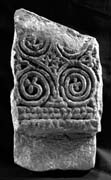
Object type: Lower part of cross-shaft [1]
Measurements: H. 47 cm (18.5 in); W. (shaft) 24.4 > 24 cm (9.6 > 9.4 in), (tenon) 23.5 cm (9.2 in); D. (shaft) 10.5 cm (4.1 in), (tenon) 9 cm (3.5 in)
Stone type: Sandstone, clean, pale buff-brown colour, medium grained, quartzose with pervasive silica cement giving a dense hard fabric. Upper Carboniferous, Millstone Grit Group. [G.L.]
Plate numbers in printed volume: Ills. 387-90
Corpus volume reference: Vol 8 p. 174-5
(There may be more views or larger images available for this item. Click on the thumbnail image to view.)
The base of a cross-shaft with a tenon. No edge mouldings survive, and the back and most of the sides are missing.
A (broad): An unusual form of bush-scroll formed from two parallel continuous scrolls with volutes facing alternately right and left. The lower volutes of both scrolls terminate in tri-lobed berry bunches, and tri-lobed buds spring from the plain binding between the lower and upper volutes. Only the lower part of the two upper volutes survives. As these turn inwards they appear to meet edge to edge. The conjunction of the four volutes creates a hollow diamond-shaped space at the centre, with buds, possibly tri-lobed, springing from each angle to form a cross, although this is now very worn. The panel is edged below by a double cable twist and a plain flat band
B and D (narrow) and C (broad): Missing. Hacked and worn.
Collingwood (1915a, 197) recognised that the style of carving of this piece is the same as Ilkley 5, and he thought it could be the foot of the same cross. If it is, it must be the base of one of the broad faces. The double cable twist, present on both pieces, suggests the possibility. The place of the bush-scroll and its 'flowering cross' centre in relation to regional styles are discussed in Chap. V, p. 54.
