Select a site alphabetically from the choices shown in the box below. Alternatively, browse sculptural examples using the Forward/Back buttons.
Chapters for this volume, along with copies of original in-text images, are available here.


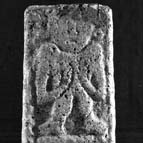
Object type: Upper part of cross-shaft [1]
Measurements: (taken from the cast) H. 51 cm (20 in); W. 30.5 > 29 cm (12 > 11.4 in); D. 18 > 17 cm (7.1 > 6.7 in)
Stone type: This is a definite cast. It consists of a coarse quartzose sand grains mixed with large angular fragments of black, glassy, furnace slag, showing conchoidal fractures (? from a metal smelting furnace). The aggregate is bound together by cement (calcium carbonate) which shows a reaction with dilute HCl acid. [G.L.]
Plate numbers in printed volume: Ills. 344, 375-8; Figs. 12, a-b
Corpus volume reference: Vol 8 p. 173-4
(There may be more views or larger images available for this item. Click on the thumbnail image to view.)
A tapering cross-shaft of rectangular section with cable-moulded angles. A narrowing at the top is original and is part of the transition to a cross-head. The carving is shallow but on three faces has a fine modelled strand, while the fourth is, unusually, incised.
A (broad): The top of this face within the shaping for the head is very worn and there is now no trace of any decoration. There is a panel divider just below this shaping: it is very worn but is clearly cabled. Below are one complete and one incomplete panel. (i) A very unusual closed-circuit pattern which looks as if it is based on a plain plait but is in fact much more complex. It incorporates single diagonals crossing from corner to corner and ending in tips like pointed buds, each bisecting two large diagonally-disposed linked ovals. Through these a plait-like element is laced, incorporating eight loop-like twists, a pair at the end of each oval emphasising the diagonal theme (see Cramp 1991, fig. 25 Av). The bottom edge of this panel is finished with a cable moulding as at the top. (ii) Very worn but the surviving upper part of the panel shows two animals with long necks crossed in the centre, the head of that on the right has its ear in the top right corner, its open jaws pointing down. The animals are involved in fine interlace.
B (narrow): (i) The lower part of a panel with interlace, of which only the joined terminal survives. Below is a double wheat-ear/cabled border now very worn. (ii) Three volutes of a continuous spiral scroll, of which the lowest is now too worn to register any details; the volute above ends in a clubbed tip forming a whorl or reversed spiral; the upper in a tri-lobed leaf-flower. Worn pointed leaves sprout in the spandrels between the upper and middle volutes (one of these appears to be of the pointed-lobed variety), and from the top right of the upper volute.
C (broad): The shaping for the head is most apparent on this face, where the edge mouldings can be seen to curve inwards at the top. This face has an inner roll moulding on its vertical edges. (i) In the shaping for the head is the lower part of an interlace terminal, apparently incised. (ii) Most of two registers of an incised interlace pattern, encircled pattern D, with a bar terminal at the top and simple pattern E loops in the glide between the two registers. The cutting is however even sketchier than in Collingwood's drawing.
D (narrow): (i) A panel with a stumpy frontal figure standing legs apart, feet in the lower corners of the panel. His arms are raised in front of him as if in prayer. No details of the head, apart from its outline, and perhaps slight indications of an incised mouth and outline nose, survive. The figure is carved as if it is a flat cut-out, with details like the neckline and arms incised within the outline. The lower border is possibly cabled. (ii) One register of modelled but distorted interlace, two registers of complete pattern A with paired joining at the top.
This extraordinary piece survives only as a cast; the whereabouts of the original is a mystery, but must be presumed to have had an existence since we have an early report of its discovery, and mention of a cast from an early date. Adcock (1974, I, 144–6) did not recognise the shaft in the museum, which she studied in some detail, as a cast, but her observations on the interlace still have validity. She noted, for example, that the distorted pattern on face D, indicative of the use or reuse of a template, is unlikely to be the work of the designer of the complex patterns on faces A and C. However, the evidence for different designers and methods on one cross is also found on Wakefield 1 (p. 267), where she suggested the patterns were drawn up but only fully or partly executed at a later date. The circled pattern D on face C is linked closely to one on a fragment from Monkwearmouth (Cramp 1984, no. 6, pl. 111.605): not only in pattern type but in the way the holes for the underlying grid are turned, even though the design on the Ilkley piece is much shallower, and cut rather jerkily. Its local analogues are discussed in Chap. V, pp. 46–7. The square panel on face A is very unusual but it has a close analogue in the main spread of pattern on a carpet page from the Book of Durrow, fol. 125v (Henderson 1987, pl. 12). Early manuscript sources could lie behind the interlace designs on both broad faces, and the shaft as a whole relates to a group of sculptures defined by Adcock as linked to the monastic sites of Lastingham in east Yorkshire and Monkwearmouth/Jarrow in co. Durham. In addition to the Monkwearmouth fragment noted above, Yorkshire members of this group include Kirby Misperton 1, Kirkbymoorside 6, and Lastingham 5 (Lang 1991, ills. 508–9, 536–7, 592–5). For a later use of the design idea for the square pattern on face A, see the cross-base Hartshead 1 (Ill. 312).
The paired animals on face A can be paralleled on the eighth-century shaft Crofton 2 (Ill. 185; see also Chap. V, p. 57). The enigmatic stumpy figure on face D, with its humped shoulders (Ill. 344), looks later than the interlace and animal designs suggest: possibly therefore this represents part of the later development of the shaft. It is only its crudity of execution which suggests this, however. Collingwood (1915a, 196, fig. i) drew and commented on a 'double curl' on either side of the head, which he compared to the halo/hair with curled ends on the Leeds shaft, no. 1 (Ills. 482–4): this diagnostic feature is however not visible today.
