Select a site alphabetically from the choices shown in the box below. Alternatively, browse sculptural examples using the Forward/Back buttons.
Chapters for this volume, along with copies of original in-text images, are available here.


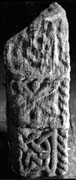
Object type: Top of cross-shaft with lower arm of -head, and foot of -shaft, in two pieces [1]
Measurements:
a: H. 43.2 cm (17 in); W. 21 cm (8.3 in); D. 15.2 cm (6 in)
b: H. 43.4 cm (17.1 in); W. (shaft) 24 cm (9.5 in), (tenon) 18.5 cm (7.3 in); D. (shaft) 14.5 cm (5.7 in), (tenon) 14 cm (5.5 in)
Stone type:
a: Poorly sorted, medium grained Millstone Grit, colour light yellowish brown (10YR 6/4).
b: As Ilkley (All Saints) 1 (p. 167). This shaft section has been slightly burnt to produce some pink (5YR 7/4) surface colouration. [J.S.]
Plate numbers in printed volume: Ills. 345-52
Corpus volume reference: Vol 8 p. 172-3
(There may be more views or larger images available for this item. Click on the thumbnail image to view.)
Two fragments of the same cross. 4a is the upper part of a cross-shaft and part of the lower arm of a -head of type D9. Its angles and dividers between decorated areas on the faces are cabled. 4b is the base of a cross-shaft, including its tenon. Most of its edge mouldings are worn or damaged, but one surviving fragment is cabled. The carving of both pieces is similar with a fine (half-width) modelled strand standing out from a roughly dressed flat background.
A (broad): This face has a continuous spiral plant-scroll: on 4a, both of the two complete volutes end in a short, triangular tri-lobed berry bunch. On 4b, only one complete volute has survived, with the same feature. The scroll on 4b appears to start from a thickened stem standing directly on the lower edge of the carved face immediately above the tenon, with no framing edge. On both fragments, rounded buds develop from the springing of each volute, on plain stems with no bindings, and triangular leaves or berry bunches drop from each scroll to fill the spandrel between it and the main stem.
B (narrow): On 4a three decorated areas survive, defined by the cusps of the neck of the cross. (i) An incomplete panel with one asymmetrical terminal loop of an interlace pattern with an outside strand. (ii) A geometric flower pattern with four pointed hollow petals forming a diagonal cross, with pointed pellets filling the spaces. (iii) An incomplete interlace with a joined terminal and one register of simple pattern E. On 4b there are two registers of the same interlace pattern, suggesting a continuous run of ornament on the side.
C (broad): Invisible on 4a (and not drawn by Allen 1884a or Collingwood 1915a); completely worn away on 4b.
D (narrow): Three decorated areas survive on 4a, defined by the cusps of the neck of the cross. The decoration of the lower panel continues on 4b. (i) An incomplete panel, worn but with traces of interlace. (ii) The same formal geometric flower as on 4aBii. (iii) A continuous changing interlace based on half-patterns with included terminals and outside strands, with on 4a one terminal register of half-pattern C, and on 4b the lower part of one register of simple pattern F (Carrick Bend), one register of half-pattern C, and a pattern A terminal.
In its style of carving and features such as the cabled edge mouldings this compares with the head fragment Ilkley 10 (p. 177, Ills. 369–72), although if that piece is part of the same cross then one has to assume the overall form of the head was type A9, with a type D9 transition to the shaft. The plant-scroll on face A with its pointed serrated leaves has features in common with other early sculptures from the same area of the West Riding (Chap. V, p. 51).
The interlace on this shaft is particularly interesting. That on face B, simple pattern E, does not appear anywhere else in Deira as a side-filling continuous pattern (Adcock 1974, I, 105). It compares most closely with sculpture from Bernicia where it appears as a compact border pattern on Monkwearmouth 21A, but as a narrow face filling (as here) on Jarrow 3B and D, though now only known from drawings and casts (Cramp 1984, 107–8, 132, pls. 91.484, 124.677). These two pieces are dated very differently: seventh century for Monkwearmouth, and tenth century — but looking back at earlier styles — for Jarrow: the important point here is the Bernician connection (see also Ilkley 5 below). The changing pattern and use of half-patterns on face D, however, place this shaft in close connection with other sculptures from the area, such the imposts from Ripon (no. 9, Ills. 671–5), and in north Yorkshire with face D of Croft 1, and the interlace patterns on faces B and D of Easby 1 (Lang 2001, ills. 151, 204–6, 210–12). These connections suggest the dating for the Ilkley piece.
