Select a site alphabetically from the choices shown in the box below. Alternatively, browse sculptural examples using the Forward/Back buttons.
Chapters for this volume, along with copies of original in-text images, are available here.


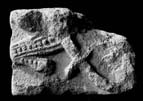
Object type: Fragment
Measurements: H. 19 cm (7.5 in); W. 14 cm (5.5 in); D. 10 cm (4 in)
Stone type: Yellowish grey (5Y 7/2), poorly sorted, coarse, bioclastic limestone with angular and sub-rounded clasts and rhombs of calcite (echinoid fragments), together with a few fragments of echinoderm spines; mostly clast supported. Bedding picked out on right-hand face by poorly aligned clasts (up to 3 mm across). Doulting stone, Upper Inferior Oolite Formation, Inferior Oolite Group, Middle Jurassic
Plate numbers in printed volume: Pl. 246
Corpus volume reference: Vol 7 p. 156
(There may be more views or larger images available for this item. Click on the thumbnail image to view.)
A: Only one face has any vestige of carving; the background where it survives is very smoothly finished. A feature which could be the body of an animal, double-outlined and enclosing a row of pellets, is crossed by a plain strand; another strand encloses the space filled by a possible foot of an animal. This also is pelleted.
B–F: All other sides have evidence for recutting, although the base is smooth and flat and could be original.
This is an elegant fragment of carving and it is unfortunate so little survives, so that one cannot even guess its form. The central pelleted feature is probably part of an animal, but there is a possibility that it is part of a plant and that the 'foot' is really a leaf. If it is an animal the body patterning is unique, but there are a variety of body patterns on ribbon animals in the south-west (see introduction p. 46), and the pelleting of plant forms would be unusual in the pre-Conquest period. The smooth finish of the background was probably designed to take a covering of paint. Altogether this piece stands out from the rest of the Glastonbury carvings in workmanship and design, and it is interesting that the stone is different from the majority of the other fragments. It is just possible that this piece is Romanesque, and part of a composition similar to a fragment which Radford assigned to Herlewin's twelfth-century church (1981, 131, pl. XXIV, D).
