Select a site alphabetically from the choices shown in the box below. Alternatively, browse sculptural examples using the Forward/Back buttons.
Chapters for this volume, along with copies of original in-text images, are available here.


Object type: Fragment
Measurements: H. 16 cm (6.25 in); W. 17.5 < 26.5 cm (7 < 10.5 in); D. max. 13.5 cm (5.25 in)
Stone type: Yellowish grey, coarse-grained, matrix supported, very shelly, bioclastic oolite. Shells (bivalve fragments) up to 10 mm across and crudely aligned to give bedding (parallel to the long axis). Ooliths weather out to give 'aero-chocolate' texture. Bradford stone
Plate numbers in printed volume: Pls. 249-50
Corpus volume reference: Vol 7 p. 156-7
(There may be more views or larger images available for this item. Click on the thumbnail image to view.)
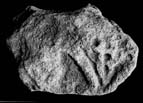
A: Only a fraction of the ornament survives, consisting of the intersection of two roll mouldings, potentially forming two round-headed arches. In the spandrel of the arcade is a interlace knot with pointed terminals and deeply marked hole points. Under the lefthand arch there are traces of relief carving.
It is unfortunate that this piece is so battered and abraded since it is delicately carved and potentially important. The interlace with its elongated pointed terminals is typical of the region (see introduction p. 41), and Rodwell has compared the arcaded decoration with the font at Wells, although there the spandrels of the arches are filled with plant sprays (see Ills. 328–45).Rodwell also has interpreted the vestige of carving under the arch as a human head, and so potentially part of a scheme of standing figures as on the Wells 4 font. This is an attractive suggestion, although the haloed head is not easy to decipher. There is a slight curve in the back of this piece and it could be part of a shrine or other church furnishing.
