Select a site alphabetically from the choices shown in the box below. Alternatively, browse sculptural examples using the Forward/Back buttons.
Chapters for this volume, along with copies of original in-text images, are available here.


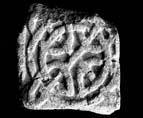
Object type: Part of a cross-shaft
Measurements: H. 25 cm (9.75 in); W. 28 cm (11 in); D. 28 cm (11 in); H. max. (estimated from Dobson 1931, pl. VII) c. 44 cm (17.5 in)
Stone type: Yellowish grey (5Y 7/2), poorly sorted, coarse, bioclastic limestone with angular and sub-rounded clasts and rhombs of calcite (echinoid fragments), together with a few fragments of echinoderm spines; mostly clast supported. Bedding picked out on right-hand face by poorly aligned clasts (up to 3 mm across). Doulting stone, Upper Inferior Oolite Formation, Inferior Oolite Group, Middle Jurassic
Plate numbers in printed volume: Pls. 224-6
Corpus volume reference: Vol 7 p. 153
(There may be more views or larger images available for this item. Click on the thumbnail image to view.)
A: One edge moulding survives and a nearly complete circular knot of encircled pattern C (Cramp 1991, fig. 19). The strand width is about 12mm. Below this was a bold cabled moulding above a plain panel (see Dobson 1931, pl. VII).
B: Roll moulding on both edges and plain panel
C: Roll moulding on one edge and a plain panel divided from median-incised interlace above by a bold cabled moulding.
D: All traces of carving obliterated
This interlace pattern is closely paralleled in a simpler form on another Glastonbury fragment (no. 3, Ill. 232), and on Ramsbury 3, Wiltshire (Ills. 498–502), as well as at Wantage in Berkshire and Wherwell in Hampshire (Tweddle et al. 1995, ills. 474–7, 479–81). It is therefore a relatively popular southern English motif. I have elsewhere noted that these interlace patterns are found in BL Cotton MS Tiberius C.II, fol. 5v (Cramp 2001, 158; see Wilson 1984, ill. 111).
