Select a site alphabetically from the choices shown in the box below. Alternatively, browse sculptural examples using the Forward/Back buttons.
Chapters for this volume, along with copies of original in-text images, are available here.


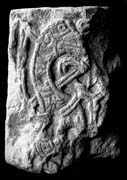
Object type: Part of a slab
Measurements: H. 31 cm (12 in); W. 24 cm (9.5 in); D. 10 cm (4 in)
Stone type: Yellowish grey (5Y 7/2), medium-grained, poorly sorted, matrix-supported oolite with variable, but sparsely scattered shell debris up to a maximum of 10 mm across. Ooliths weather out to give the 'aero-chocolate' texture. Bath stone, Chalfield Oolite Formation, Great Oolite Group, Middle Jurassic
Plate numbers in printed volume: Pls. 227-31, Fig. 20b
Corpus volume reference: Vol 7 p. 153-4
(There may be more views or larger images available for this item. Click on the thumbnail image to view.)
A (broad): An animal is shown in profile, enmeshed in median-incised interlace. Since only the upper part of the body survives it is not possible to say whether it was a biped or quadruped. Its chest is puffed out, its long neck is curved, terminating in a rounded head with sharply pricked ear which extends into interlace. Its eye is back-pointed with a rounded and deeply marked pupil, and behind the eye there is a scroll which forms the base of the ear. Its mouth is slightly open and there is a curl in front of the face, but the surface there is chipped away. Its body is double-outlined and patterned with discontinuous blocks of horizontal grooves and a sub-rectangular panel with a dotted centre. Within the curve of the neck and in front of the body, interlace branches from a straight upright strand, loops and crosses behind the neck, whilst a second strand passes over the body and loops under the first strand to form an ear extension.
B (narrow) and F (bottom): Broken off
C (broad) and E (top): Smoothly dressed
D (narrow): Tooled off with a large chip at the base
The roll moulding on the left indicates that the field ends there and so the animal's body cannot have extended far in that direction, indicating that it may have been a biped rather than a quadruped. Earlier commentators have seen the creature as beaked, but the damage in front of its mouth gives a misleading impression and I have suggested elsewhere that the broken mouth can be reconstructed as partly open to shoot out a long coiling tongue in the manner of the Cropthorne quadruped, or as in manuscripts such as the head on the arcade terminals of BL MS Royal 1. E. VI., fol. 4r (see Cramp 2001, 155, fig. 4, and here Fig. 20). The body patterning of the animal with little blocks of ribbing, and indeed its stance, may be closely paralleled in the south-western Mercian sculptures such as at Cropthorne or Gloucester (Webster and Backhouse 1991, 241, 244, ill. 209 and fig. 25), and within Wessex it shares several features such as the form of the eye and the coil behind the ear with the Colerne beasts (Ill. 434; see introduction p. 46). And as I have suggested elsewhere (Cramp 2001, 157), the straight strand before the animal's chest and the way it branches into a loop could suggest that this animal was one of a pair of confronted beasts. The Mercian influence on this piece could well reflect the domination of the Mercian rulers in Glastonbury's affairs in the second half of the eighth century (Cramp 2001, 158; and introduction p. 6).
