Select a site alphabetically from the choices shown in the box below. Alternatively, browse sculptural examples using the Forward/Back buttons.
Chapters for this volume, along with copies of original in-text images, are available here.


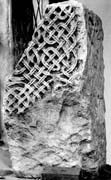
Object type: Lower part of shaft
Measurements: H. 57 cm (22.5 in); W. 32 < 37 cm (12.5 < 18 in); D. 25 < 27.5 cm (9.75 < 10.75 in)
Stone type: Yellowish grey (5Y7/2), medium-grained, shelly, clast-supported, oolitic limestone partially covered with a render. Ooliths are mostly in the range 0.3 to 0.5 mm diameter, with a few up to 0.9 mm, and stand proud. A few ooliths? (?well-rounded clasts) are up to 2 mm diameter. Sub-rounded to well-rounded clasts are also present. Some platy bivalve fragments up to 5 mm across occur. Portland stone, Portland Freestone Member, Portland Limestone Formation, Portland Group, Upper Jurassic
Plate numbers in printed volume: Pls. 65-9
Corpus volume reference: Vol 7 p. 103
(There may be more views or larger images available for this item. Click on the thumbnail image to view.)
A (broad): Vestiges of a fine plant-scroll with small pointed berry bunches and one pointed and veined leaf surviving. Most of the face has been obliterated by the superimposition of a sundial measuring 26 cm (10.25 in) across, and 15.5 cm (6.25 in) high. The hole for the gnomon and five tide lines are extant.
B (narrow): This face is very worn and damaged, but what may be two pairs of simple pattern E knots joined by a central twist survive.
C (broad): Hollowed out at the back, probably for reuse as stoup? All decoration completely lost.
D (narrow): Fine median-incised irregular interlace.
E (top): Square socket hole 22 x 20 cm, depth 16 cm
Gillingham was obviously an important Anglo-Saxon centre, probably a minster site with several dependent chapels (Hall 2000, 15, fig. 6), one of which was East Stour with which this piece has obvious stylistic parallels (Ills. 57–64). Since the opposite face (C) to that with the plant-scroll is lost, one cannot tell whether this shaft had the same formula of alternating plant-scrolls and interlace, but the style of its cascading grape bunches and the elegant median-incised interlace is very similar to East Stour, and it must be very close in date to that shaft. A similar interlace composition with sharply cut median-incised strands is also found at Hanging Langford, Wiltshire (Ill. 452). The interlace here is indeed more controlled and confident than on East Stour or Hanging Langford and one can only lament the loss of so much of the detail on this fragment.
