Select a site alphabetically from the choices shown in the box below. Alternatively, browse sculptural examples using the Forward/Back buttons.
Chapters for this volume, along with copies of original in-text images, are available here.


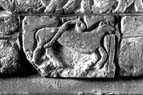
Object type: Rectangular slab
Measurements: H. 17 cm (6.25 in); W. 24.5 cm (9.5 in); D. Built in
Stone type: A heavily patinated, medium-grained, bioclastic limestone. The surface is a reddish brown and patinated, but broken areas, still with a polished surface, are a yellowish grey (5Y 7/2). Clasts, which vary from 0.2 to 1.0 mm across, are sub-angular to sub-rounded; no large shell fragments. Doulting stone, Upper Inferior Oolite Formation, Inferior Oolite Group, Middle Jurassic
Plate numbers in printed volume: Pl. 223
Corpus volume reference: Vol 7 p. 152-3
(There may be more views or larger images available for this item. Click on the thumbnail image to view.)
The surface of the stone has been cut back, leaving a very irregular surround for the animal, with a neat flat-banded border at one side and irregular surroundings on the left and top. In fact the piece could be half finished, since only on the base of the slab has the background been fully carved away. The surface of the stone is highly polished. Filling the frame and in part cutting into it is a profile quadruped running to the right. The body tapers to the hips and the head is rather small in relation to the body. It has a squared-off muzzle, pricked-up ear and lentoid eye. Its long tail curls between its back legs, passes over its body and ends in a coil over its back. There has been some attempt to carve its threetoed feet, and this seems to indicate a canine creature.
Although the surface of the stone is carefully prepared and the carving is quite skilful, this animal lacks a context as part of a monument. If this is not an apprentice piece then it is rather like the doodles of individual creatures such as one finds in the margins of manuscripts such as Vatican, Biblio. Apostolica MS Reg. lat. 12 (Temple 1976, 100, no. 84, ill. 262), dated to the second quarter of the eleventh century. Foster has rightly advised caution in dating this piece, but a late Saxon date seems more plausible than Norman.
