Select a site alphabetically from the choices shown in the box below. Alternatively, browse sculptural examples using the Forward/Back buttons.
Chapters for this volume, along with copies of original in-text images, are available here.


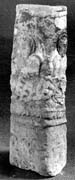
Object type: Part of round shaft
Measurements: H. 73.5 cm (29 in); W. 23 > 21.5 cm (9 > 8.5 in); D. 16 > 14 cm (6.5 > 5.5 in)
Stone type: Much of the surface covered with lichenweathered holes to give a superficial resemblance to Bath stone. Yellowish grey (5Y 7/2), shelly, medium-grained oolite. Most ooliths are in the range 0.3 to 0.5 mm diameter, with a few up to 0.6 mm, closely packed, but nevertheless matrix-supported. Scattered shell fragments up to 5 mm across. ?Osmington Oolite, Corallian Group, Upper Jurassic
Plate numbers in printed volume: Pls. 153-9
Corpus volume reference: Vol 7 p. 127
(There may be more views or larger images available for this item. Click on the thumbnail image to view.)
About 20 cm of the lowest portion of the shaft is uncarved; above is a thick cable moulding enclosed by a broad rounded moulding below and a narrower one above, the whole about 8.5 cm in depth. Above that is a band of plain plait work, which neatly turns the corner and binds the arms of the two figures above tightly to their bodies. The figures are framed by arches joined by one surviving column with a worn cup-like capital. Both figures have hunched shoulders and dished haloes, but the details of the figure on the south-east side (Ill. 157) are less well preserved. Both have wedge-shaped, beardless faces with short hair, revealing prominent ears set high on their heads. The northern figure (Ill. 158) has bulging oval eyes and a deeply incised mouth. Both are dressed in a tightfitting long-sleeved garment with a V-neck. Above the enmeshed figures the stone is plain, but there seems to have been a projecting scalloped band, rather like a metal binding, at the top.
Yetminster was a possession of the bishop of Sherborne, and has been judged to be a definite 'minster' site with a large parochia which included Melbury Bubb, Melbury Osmond and Batcombe (Hall 2000, 100, fig. 79). This curious shaft is however something of an oddity in this region. There are other round shafts in Wessex such as the shafts from Wantage (Tweddle et al. 1995, ills. 474–7), Winchester High Street (ibid., ills. 679–82) and Winchester Priors Barton (ibid., ills. 686–90), as well as the curious columns from Wareham (Ills. 114–17, 122–5) which could be Roman, but this is unlike them in its decoration. The haloes on the figures would indicate that they were meant to be divine, possibly saints, and the position of perhaps four figures under arches separated by columns could indicate saints or Evangelists, but their binding and hunched shoulders are more like the Vikingage figures in Northumbria. As Bailey noted, 'Similar deformed men are spread across Northumbrian sculptures from the Solway to the Tees valley during the Viking period' (Bailey and Cramp 1988, 121). A very similar figure occurs at Ilkley in Yorkshire but without a halo (Ill. 545; Cramp 1982, 17, pl. 20a), and a similar secular figure with sword and shield is enmeshed in interlace on the round shaft at Brailsford in Derbyshire (Kendrick 1949, pl. XLVI). Although these have been compared with the bound 'horned' figure from Kirkby Stephen in Cumbria (Bailey and Cramp 1988, ill. 390), the Ilkley and Yetminster figures are more like another figure on a disc-headed shaft in the Isle of Man, Keeil Chiggyrt (Kermode 1907, pl. XVIII, no. 51). The figures on the Yetminster shaft are however unique in their haloes, and such figures may be more 'native' than Scandinavian, and based on a local tradition. Despite Kendrick's valiant attempt to characterise these figures as 'a "sub-Carolingian kind"' (Kendrick 1949, 72), they are best seen as rustic work in the style of a later age than their inspiration, which is almost certainly the arcaded figures of saints or Evangelists that are so popular in eighth- and ninth century Northumbria and Mercia (cf. Kendrick 1938, pls. LXX and LXXIV).
