Select a site alphabetically from the choices shown in the box below. Alternatively, browse sculptural examples using the Forward/Back buttons.
Chapters for this volume, along with copies of original in-text images, are available here.


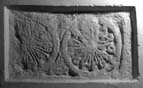
Object type: Fragment with two circular panels
Measurements: H. 16.5 cm; W. 30.5 cm; D. Built in
Stone type: Heavily lime-encrusted, pale yellowish grey (5Y 7/2), clast-supported, bioclastic limestone. Clasts subangular to sub-rounded and up to 2.5 mm across. One small area shows clasts fairly well graded between 0.4 and 0.6 mm. Doulting stone, Upper Inferior Oolite Formation, Inferior Oolite Group, Middle Jurassic
Plate numbers in printed volume: Pls. 160-1
Corpus volume reference: Vol 7 p. 129
(There may be more views or larger images available for this item. Click on the thumbnail image to view.)
Only one face is visible. Edged at one side by a flat-band moulding is a design of two contiguous circles in relief, which enclose on the left a rosette with elongated scooped petals with rounded tips marked by a dot. On the right the rosette is not complete but the petals are a different shape with inturned tips and a raised triangular centre.
Appendix A item (stones dating from Saxo-Norman overlap period or of uncertain date).
Whether this was originally an impost or some other architectural feature cannot be determined from this fragment. Such rosettes are not common in Anglo-Saxon art but they could have been inspired by the roundels filled with very similar petalled motifs which are seen on the frames of illustrations found in the manuscript Cambridge, Pembroke College 301, fol. 2v and fol. 10v (Temple 1976, 191–2, ills. 233–4), which has been dated c. 1020. On the other hand the contiguous circles are more common in Romanesque art. Compare also the grave slab from Gore Cross, Wiltshire (p. 236, Ills. 525–6).
