Select a site alphabetically from the choices shown in the box below. Alternatively, browse sculptural examples using the Forward/Back buttons.
Chapters for this volume, along with copies of original in-text images, are available here.


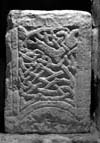
Object type: Part of shaft
Measurements: H. 52.7 cm (20.75 in); W. 37.5 > 35.5 cm (14.75 > 14 in); D. 21.5 > 20.25 cm (8.5 > 8 in)
Stone type: Very weathered patina; top with polished top surface; basal two-thirds lichen encrusted. Yellowish grey (5Y 7/2), medium-grained, bioclastic limestone, with bioclasts sub- to well-rounded and clast supported. Clasts range from 0.3 to 0.8 mm across, but most are in the range 0.3 to 0.5 mm. ?Doulting stone, Upper Inferior Oolite Formation, Inferior Oolite Group, Middle Jurassic
Plate numbers in printed volume: Pls. 142-3
Corpus volume reference: Vol 7 p. 124
(There may be more views or larger images available for this item. Click on the thumbnail image to view.)
A (broad):A double flat-band moulding partially survives. The face is divided by a round-headed incised arch. Above is an extended animal. The head on the right is turned back, jaws open and curling back, and it has a well-marked oval eye with dotted centre. Its body seems to be outlined and its front leg is extended, finishing in a lumpy foot. The rest of the body tapers into interlace which intermeshes with its tongue and ear extensions in the centre of the panel. The interlace is deeply cut, with pointed terminals and median-incised strands, c. 2 cm wide. Any carving below the arch has been entirely obliterated, but it is possible, as with Whitcombe 2, that it was originally plain.
B (narrow): Plain
C (broad): Back plain
D (narrow): Side plain, diagonal chisel marks
E (top): Rectangular socket, 21.5 x 12.75 cm (8.5 x 5 in) at top, tapering to 19 x 9 cm (7.5 x 3.5 in) at base.
The pattern is complete. This animal is unique in Wessex sculpture, but might be compared with metalwork like the more elegant creature on the Fetter Lane sword pommel (Kendrick 1938, pl. LXXIX), or even later ornament which has been influenced by Scandinavian Urnes style.
The incised arch is also present on Whitcombe 2 and it seems likely that these were both parts of the same monument, the socket at the top of Whitcombe 1 being to fit another shaft section or perhaps a head.
