Select a site alphabetically from the choices shown in the box below. Alternatively, browse sculptural examples using the Forward/Back buttons.
Chapters for this volume, along with copies of original in-text images, are available here.


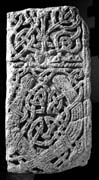
Object type: Part of a cross-shaft
Measurements: H. 76.5 cm (30 in); W. 37 cm (14.5 in); D. 35 cm (13.75 in)
Stone type: Yellowish grey (5Y 7/2), poorly sorted, matrix-supported, shelly oolite; shell fragments up to 7 mm across. Ooliths weather out to give 'aero-chocolate' texture. Bath stone, Chalfield Oolite Formation, Great Oolite Group, Middle Jurassic
Plate numbers in printed volume: Pls. 346-51
Corpus volume reference: Vol 7 p. 178-9
(There may be more views or larger images available for this item. Click on the thumbnail image to view.)
The surviving faces are edged by a wide roll moulding with a fine inner moulding.
A: Remains of two panels divided by a cable moulding. The left side of the face has been cut away. The upper panel has part of a bush-scroll springing from a domed root. All of the stems are median-incised, and the central stem is divided by 'cups' from which spring the side tendrils. Each tendril volute ends in a small triangular leaf with a deeply indented centre, and the terminations of the upper tendrils link through the knots below.
In the lower panel are two confronted serpentine creatures whose bodies cross at the base, and they are enmeshed and divided by interlace which derives from their ear (and probably tail) extensions. Their bodies are outlined by a fine moulding and filled with two rows of pellets divided by a mid-rib. Their heads are canine in type with dotted eyes and nostrils, and their tooth-filled jaws are closed, although a strand seems to pass through the jaws of the creature on the left.
B: The right side is cut away and patches of mortar cover some of the detail of the animals. This face is filled with serpentine creatures enmeshed in median-incised interlace. The bodies cross twice and at the base seem to be narrowing into tails, but there are no heads surviving at the top. The decoration of the bodies is the same as on face A.
C: Broken and recut, with a partial chamfer between faces C and D
D: Recut but smoothly dressed with traces of red and white paint
E: Smooth, with a dowel hole in the centre, rectangular at the top, 9 x 5.8 cm (3.5 x 2.25 in), and round in the interior, depth of hole 8.5 cm (3.25 in)
The heads of the creatures on face A are most like Colerne, especially Colerne 1b (Ill. 435), but they are less dynamic and savage. Nevertheless the bushscroll in the panel above does seem to be a link with earlier sculptures, such as St Oswald's, Gloucester (see Ills. 543–4), where animals and plant-scrolls occur together, rather than with those monuments such as Ramsbury, Wiltshire, where only ribbon animals and interlace are juxtaposed (Ills. 485–7, 492, 495–7). The fact that there is a hesitation in the composition, and the angularity of the scroll, may indicate that the sculptor was closely following a model (see introduction p. 46).
Foster (1987, 78) saw chevrons on the left-hand creature though I could not, but the body patterning on the animals here is most like Tenbury Wells, Worcestershire (Cottrill 1935, pl. XVI; see Ill. 547) which also has the same formula of undulating bodies as on face B. Tweddle, when discussing these animal types, noted that the 'paired animals whose bodies undulate regularly, crossing and recrossing', are also found in the St Petersburg Gospels and at Dolton, Devon (Ills. 20–3) and Steventon, Hampshire (Tweddle et al. 1995, 39, fig. 12, ills. 471–2), so this is a widespread phenomenon.
