Select a site alphabetically from the choices shown in the box below. Alternatively, browse sculptural examples using the Forward/Back buttons.
Chapters for this volume, along with copies of original in-text images, are available here.


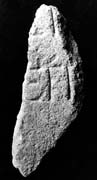
Object type: Fragment of an inscribed stone
Measurements: H. 20 cm (8 in); W. 6.5 cm (2.5 in); D. 11.8 cm (4.7 in)
Stone type: Yellowish grey (5Y 7/2), medium-grained, bioclastic limestone. Most clasts are about 0.5 to 0.6 mm across, but many are much finer (down to 0.3 mm). A few scattered shell fragments up to 5 mm across. Doulting stone, Upper Inferior Oolite Formation, Inferior Oolite Group, Middle Jurassic
Plate numbers in printed volume: Pl. 372
Corpus volume reference: Vol 7 p. 187
(There may be more views or larger images available for this item. Click on the thumbnail image to view.)
Inscription The inscribed face, which is finely dressed, is the only original surface. Parts of two lines of incised lettering remain. The only clearly complete letter, the T of line 2, is 3.9 cm high. The substantial uninscribed area below the second line indicates that it was the last line of an inscription of at least two lines. The letters were cut with a distinct Vsection, and strokes terminate in neat serifs.
— . . —
—[E]T[ . ]—
The recognisable letters are capitals but, as only two letters can be read with certainty, neither language nor meaning can be identified. The horizontal remaining from the bottom of the first letter in line 1 suggests that it was L or E, or perhaps rectangular C. The vertical to the right of this may have been part of I, M, N, P, R or T. The third letter of line 2 looks at first sight like I but a short section of a lightly incised horizontal running to the right from the top of the vertical and a very slight indication of a horizontal running to the right from the stem about 1.8 cm from the top suggest F, or perhaps a form of P or R with a closed bow. The letters seem to have been neatly and evenly set out, probably following ruled guide-lines, although none is now visible. There are some irregularities in execution such as the slightly crooked stem of the T and the manner in which the tops of the E and T run together.
Appendix A item (stones dating from Saxo-Norman overlap period or of uncertain date).
Inscription The E and T follow the forms of the 'Roman' capitals but these are forms that were employed not only in Roman inscriptions but throughout the Anglo-Saxon period, and beyond. Okasha (1992a, 58) classes the letters as 'Anglo-Saxon capitals', whereas Rodwell (2001b, 49–50) came to the cautious conclusion that they probably date 'from somewhere between the late Roman and the late Saxon periods'. He would prefer, however, to see the use of Doulting stone, which is known to have been used in some Roman but no Anglo-Saxon contexts, as a possible indication of a late Roman or sub-Roman date. Unfortunately this argument must remain inconclusive, since it cannot be proved that Doulting was never used (or re-used from a Roman context) in the Anglo-Saxon period. See for example, Wareham 1–9, Whitcombe 1–2, Winterbourne Steepleton 1 (pp. 116–25).
