Select a site alphabetically from the choices shown in the box below. Alternatively, browse sculptural examples using the Forward/Back buttons.
Chapters for this volume, along with copies of original in-text images, are available here.


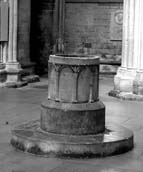
Object type: Font [1]
Measurements: H. of font bowl (excluding plinth and step) 61 cm (24 in), external diam. 73 cm (28.75 in)
Stone type: Yellowish grey (5Y 7/2), medium-grained, matrix-supported, shelly oolite with the ooliths weathering out to give an 'aero-chocolate' texture. The ooliths are mostly in the range 0.3 to 0.5 mm diameter. Shells common and aligned to pick out the bedding. Bath stone, Chalfield Oolite Formation, Great Oolite Group, Middle Jurassic
Plate numbers in printed volume: Pls. 328-45
Corpus volume reference: Vol 7 p. 177-8
(There may be more views or larger images available for this item. Click on the thumbnail image to view.)
A firm case has been made by Rodwell that the plinth and circular step date to the late twelfth century (Rodwell and West 2001, 158) and so they are not described here. The font bowl is cylindrical and tubshaped, and is cut from a single block. A broad band at the top is set back and encircled by a plain roll moulding. Beneath this is an arcade of eight pointed arches which spring directly from chamfered columns and rectangular chamfered bases with broach stops. Within the spandrels of the arches are plant-sprays consisting of pairs of long pointed leaves framing a single bud or flower, which, despite the battered nature of this element are clearly each subtly different. For instance the mutilated leaves between bays ii and iii seem to be of a different type and the central leaf-flower between iv and v is the most elaborate. The area between the arches is smoothly dressed to an almost polished surface, but on this there are faintly discernible standing figures and traces of paint.
Any discussion of this piece is heavily dependent on the recent publication of a minute study of the font by Warwick Rodwell, in which he has isolated at least two phases of remodelling (Rodwell and West 2001, 153–4, 158–9, fig. 132A). The first of these, he argues, was when original rounded and segmental arcades, set on block capitals (as suggested by the incised lines on the pilasters) were reshaped into a pointed form. This, he suggests, was perhaps when the font was reset on the present plinth and step. At the same time the blind arcading was reshaped, and possibly the capitals removed and the bases formed. At some later stage the figures between the arcades were carefully removed and the font was enveloped in a plaster skim which covered the floral features in the spandrels of the arches, to provide the effect seen in the 1827 drawing of John Buckler (ibid., 159, fig. 134). The recutting of the pilasters and the addition of new bases with broach stops to form a 'Gothic Arcade' does seem a considerable task, but if there were a strong desire to preserve the font, rather than as so often happened in the Middle Ages to replace it, then a case can be made. The shadows of figures are undoubtedly there (ibid., fig. 129), and figures under arcades are as much an Anglo-Saxon as a Romanesque phenomenon. The local fragmentary example at Glastonbury (no. 9, Ills. 249–50) is matched by other more complete monuments such as the Hedda shrine at Peterborough (Wilson 1984, ill. 93), the panel from a shrine at Hovingham (Lang 1991, ills. 494–9), or the sarcophagus fragment from Castor (Cramp 1977, fig. 57b). Rodwell notes that on all of the Midland and Northumbrian examples the shafts between the bays are rounded, but the shafts supporting the segemental arches which frame the two standing figures at nearby Congresbury (Ills. 206–8, 219–20) are rectangular. This local example adds force to the suggestion that recutting of such simple forms would have added 'elegance' to the original, just as the different spaces between the bays is a further support for reworking. The foliage sprays, with their long curved leaves and pointed buds, rosettes or leaf-flowers, are the clearest pre-Conquest survival of the ornament, and if they have been protected by a plaster covering in the post-Reformation period then so has the ornament on the font from Dolton, Devon (Ills. 15, 20–3), which likewise was covered with plaster at some unspecified time (p. 83 above). Rodwell has therefore made his case for the rare survival of this font from the pre-Conquest period (see also introduction pp. 38–40).
