Select a site alphabetically from the choices shown in the box below. Alternatively, browse sculptural examples using the Forward/Back buttons.
Chapters for this volume, along with copies of original in-text images, are available here.


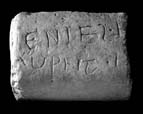
Object type: Inscription on half-rounded block [1] [2]
Measurements: L. 34 cm (13.25 in); W. 24 cm (9.5 in); D. 24 cm (9.5 in)
Stone type: Pinkish grey (5YR 8/1), fairly well sorted, medium-grained, clast-supported limestone. Clasts mostly in the range 0.3 to 0.5 mm, with a few up to 0.7 mm. The majority of the clasts are sub-rounded to rounded, with the well-rounded clasts resembling ooliths. Doulting stone, Upper Inferior Oolite Formation, Inferior Oolite Group, Middle Jurassic
Plate numbers in printed volume: Pls. 137-9
Corpus volume reference: Vol 7 p. 121-2
(There may be more views or larger images available for this item. Click on the thumbnail image to view.)
Inscription An inscription in two lines incised into a re-used, presumably Roman, fragment of a column drum (R.C.H.M.(E.) 1970b, 308, no. iv; Radford and Jackson 1970, 312). The stone has been cut back at either end, with the loss of text at the beginning and end of both lines.
— [E]NIEL :[F] —
— [A]VPR[I]T : I[ . ] —
The probable F at the end of line 1 is separated from the previous word by a mid-line point and is very likely in this context to be the first letter of Latin FILIVS ('son'), although there is no clear sign of the I ligatured with the probable F that Radford and Jackson thought probable (1970, 312). Their reconstruction of the last word as I[ACET] is also very uncertain. The first word can probably be reconstructed as [D]ENIEL, from the biblical Daniel (Radford and Jackson 1970, 312; Sims-Williams 2003, 93 (n. 478), 189, 196, 206). The second name may have been Brittonic (Radford and Jackson 1970, 312; Sims-Williams 2003, 72 (n. 330), 113, 131, 177, 179, 198). Sims-Williams (2003, 87–8), however, suggests that it may instead have been an English name: 'ælfred (or, less likely, (E)aldfrith) — or a close Germanic cognate — which was transmitted or inscribed at Wareham in a Continental (Breton?) environment'. This name is separated from the following word by a second mid-line point.
The lettering was lightly incised and informally laid out, with letters varying in height between the 8 cm of the P and the 3.2 cm of the V. Clear forked serifs can be seen on some of the letters (ENI in line 1 and probably also on the V and the Is in line 2) but the terminals of other letters are plain. The second E, I, N and perhaps also P have the forms of the Roman capitals, whilst the L, R and the T derive from Insular half-uncial letters. The round E and V are perhaps better seen as rounded versions of the capitals rather than half-uncial derivatives. The slightly sinuous diagonal at the beginning of line 2 was most probably part of capital A. (The uncial form of A suggested by Radford and Jackson (1970, 312) seems not to occur in early medieval Welsh or south-western British inscriptions.) Their '8th-century, perhaps rather late' dating is more precise than is justified by the evidence they adduce. The parallels for forked serifs cited in the discussion of Wareham 5 (p. 119) make an earlier dating, perhaps as early as the later seventh century, possible. Sims-Williams' assigning of the text of this inscription to his Brittonic Periods 17–18 implies a dating to about the eighth century on phonological grounds (Sims-Williams 2003, 286–7, 291, 294, 366, table 3.5).
Inscription The inscription on Wareham 8 commemorated an individual with a male name of biblical origin and probably also identified him as the son of another individual. The lettering and linguistic forms (as far as they can be identified) suggest a dating in the seventh and or eighth century.
Sims-Williams has shown that the perhaps now incomplete second name could have been Brittonic. He does, however, offer the alternative explanation that AVPRIT could be a plausible rendering of an English, or at least Germanic, name 'in a Continental (Breton?) environment'. This would be understandable, he argues, 'in view of the well-known presence of foreign clerics, including Bretons, in the Anglo-Saxon church; [D]ENIEL may even have been a Breton. All this depends, of course, on whether the inscription can be placed late enough to fit such an historical context, and the catch is that the later it is put the harder it is to accept that /f/ could still be spelt P' (Sims-Williams 2003, 88). This would support the hypothesis that all (McClure 1907), or perhaps some (Hinton 1992), of the Wareham inscriptions should be associated with Breton exiles of the later ninth or tenth century. On the other hand, the use of forked serifs in this inscription and the presence in the inscriptions of Wareham 5, 6 and 7 of features that suggest datings between the seventh and early ninth centuries are all arguments against such a late dating.
[1] The unique collection of sculpture from this site includes some possible Roman stones, as well as five Brittonic inscriptions which have generally been dated between the seventh and ninth century, and thus seem to have been produced within the period of the Anglo-Saxon hegemony. Although these have been included in recent catalogues and discussions of the inscriptions by Celtic specialists (see the Celtic Inscribed Stones Project on-line database and Sims-Williams 2003), they were excluded from Okasha's south-western corpus (Okasha 1993, appendix D). They have therefore been considered in some detail here (see Wareham 5–9 below), and are discussed in John Higgitt's chapter of the introduction, p. 65.
