Select a site alphabetically from the choices shown in the box below. Alternatively, browse sculptural examples using the Forward/Back buttons.
Chapters for this volume, along with copies of original in-text images, are available here.


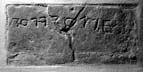
Object type: Slab with inscription [1] [2]
Measurements: H. 20 cm (8 in); W. 49.5 cm (19.5 in); D. Built in
Stone type: Yellowish grey (5Y 7/2), medium-grained, clast-supported limestone. The majority of the clasts subrounded to rounded, with the well-rounded clasts resembling ooliths, and in the range 0.3 to 0.6 mm, with a few up to 1.0 mm. Doulting stone, Upper Inferior Oolite Formation, Inferior Oolite Group, Middle Jurassic
Plate numbers in printed volume: Pls. 140-1
Corpus volume reference: Vol 7 p. 122-4
(There may be more views or larger images available for this item. Click on the thumbnail image to view.)
Inscription A one-line inscription incised into the dressed flat surface of a stone (R.C.H.M.(E.) 1970b, 308, no. v; Radford and Jackson 1970, 312). Perhaps a re-used piece of Roman masonry, but, since it is now built into a wall, the other surfaces of the stone are not visible. Cracks in the stone have damaged the fourth and fifth letters. The inscription now consists of a single word, although it is possible that there may have been further letters to the left of or above what remains of the stone.
GON[GO]RIE
This was probably the Latin genitive of a woman's name. Radford and Jackson (1970, 312) suggested that it represented an unrecorded Old Welsh name. For Sims-Williams (2003, 32 (n. 58), 89, 101 (n. 539), 129, 216 (n. 1338)) the reconstruction of the two damaged letters is uncertain and so the name is doubtful. He discusses two possible Brittonic interpretations of the name but is also prepared to consider the suggestion by McClure (1907, 729), who read Gongdrie, that it could have been a Frankish female name.
The lettering is confident in design but irregular in size, with letters ranging in height between the 2.5 cm of the first O and the 5 cm of E at the end. The forms are mixed. G, N and R are related to the Insular half-uncial letters. The sinuous right-hand stroke of the R runs more or less horizontally from the top of the letter rather than curving down towards the base-line, as was usual in the manuscript lettering. Comparable forms of R can be found in Wales and Cornwall in a number of inscriptions in predominantly Insular half-uncial lettering (Nash-Williams 1950, figs. 45, 123, 188?, 258, 259; Okasha 1993, table 2b). The three Cornish parallels (Cardinham I, Lanherne and Waterpit Down) are all on free-standing stone crosses of perhaps the tenth century. The E with its three horizontal strokes on the other hand is a version of the capital, although the meeting of the top and bottom strokes with the vertical is rounded rather than angular. The forms of the I and O could derive from either Insular half-uncials or capitals.
A distinctive feature of this inscription is the pronounced, slightly ascending horizontal lead-in to the verticals of N and R. Comparable lead-ins can be seen on some of the letters of the damaged Insular half-uncial inscription at Tywyn (Towyn) in Gwynedd (Radford and Jackson 1970, 312; Nash-Williams 1950, no. 287, fig. 188, pl. XXIII; Williams 1972, 25–40, pl. I; Redknap 1991, 60 and photos on 64). The Tywyn inscription has been assigned to various dates between the seventh and ninth centuries but Sims-Williams has recently argued for a firmly ninth-century dating, revising his previous 'date nearer 800 than 700' (Sims-Williams 2003, 294–5; Sims-Williams 1991, 22–3). The elegant 'hooks' leading into several of the letters in the inscriptions on the eighth century Pictish sword-chapes found in the St Ninian's Isle hoard provide a less angular parallel and probably had their origin in the serifs of manuscript script (Brown 1993, 245–7, ills. 72–3; Jackson 1973, 171–3, fig. 29, pl. XXIX).
The first of the two damaged letters retains an upper horizontal which turns downwards into a diagonal stroke at its right end. This resembles the top of the Insular half-uncial G at the beginning of the text, and that is the most probable reconstruction of this letter. What remains of the next letter resembles the slightly angular O of the second letter. What might be a short stroke extends outwards a little way at the top left of the letter. This led McClure (1907, 729) to read the letter as D, presumably the uncial-derived variant often used in Insular halfuncial. Sims-Williams (2003, 216, n. 1338) reads it as the leftwards extension of the upper stroke of an Insular halfuncial T. In either case, this little mark would make an unusually short stroke and it is more probable that it is simply the effect of damage. O is the most probable reading.
Inscription The inscription on Wareham 9 probably commemorated a woman whose name was perhaps Brittonic. Given his uncertainty about the reconstruction and interpretation of the name, Sims-Williams' assignation of it to his Brittonic Period 14–28 (that is, by implication, to between the second half of the sixth and the ninth centuries) must be regarded as tentative (Sims-Williams 2003, 264, 291, 366). Although difficult to parallel exactly, the lettering finds analogies amongst Welsh and Cornish inscriptions. There seem to be no grounds for a close dating of the lettering, but the comparison with the Tywyn inscription and the parallels for the R, while far from exact, suggest that this may be the latest of the five Wareham inscriptions and may perhaps be datable to the ninth century. If, as is probable, the stone was re-used in the Anglo-Saxon church of perhaps around 800, the date is unlikely to have been very far into the ninth century.
[1] The unique collection of sculpture from this site includes some possible Roman stones, as well as five Brittonic inscriptions which have generally been dated between the seventh and ninth century, and thus seem to have been produced within the period of the Anglo-Saxon hegemony. Although these have been included in recent catalogues and discussions of the inscriptions by Celtic specialists (see the Celtic Inscribed Stones Project on-line database and Sims-Williams 2003), they were excluded from Okasha's south-western corpus (Okasha 1993, appendix D). They have therefore been considered in some detail here (see Wareham 5–9 below), and are discussed in John Higgitt's chapter of the introduction, p. 65.
