Select a site alphabetically from the choices shown in the box below. Alternatively, browse sculptural examples using the Forward/Back buttons.
Chapters for this volume, along with copies of original in-text images, are available here.


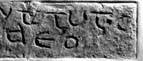
Object type: Slab with inscription [1] [2]
Measurements: H. 28 cm (11 in); W. 114 cm (45 in); D. Built in
Stone type: Heavily weathered surfaces with little fresh exposure. Consists of a pale yellowish brown (10YR 6/2), medium-grained, clast-supported limestone with a few scattered bivalve fragments. Clasts mostly in the range 0.4 to 0.7 mm diameter. The majority of the clasts subrounded to rounded, with the well-rounded clasts resembling ooliths. Doulting stone, Upper Inferior Oolite Formation, Inferior Oolite Group, Middle Jurassic
Plate numbers in printed volume: Pls. 134-6
Corpus volume reference: Vol 7 p. 120-1
(There may be more views or larger images available for this item. Click on the thumbnail image to view.)
Inscription An inscription in two lines incised into the dressed flat surface of what was probably a re-used piece of Roman masonry (R.C.H.M.(E.) 1970b, 308, no. iii; Radford and Jackson 1970, 311–12). The right-hand end of the upper line is lost. Letters may also have been lost to the left of the first letter in the lower line, although this is uncertain.
CA[TG]VG : C—
—LIV[S] : G[ID]EO
The text seems to have consisted of two names linked by Latin [FI]LIVS ('son'). The first name is Brittonic (Radford and Jackson 1970, 312; Sims-Williams 2003, 68, 113, 135, 201, 225). There is some uncertainty about the reading of the fourth letter. Plausible cases have been made both for reading it as T corrected to G and vice versa (Sims-Williams 2003, 201). A mid-line point separates this name from a following word beginning with C, perhaps, as Radford and Jackson suggest, an adjectival epithet. The second name, also separated from the preceding word by a mid-line point, has been taken as Biblical Gideon, with loss of the final consonant (Radford and Jackson 1970, 322; Sims-Williams 2003, 111, n. 605).
The lettering is irregular in layout but was cut with a bold U-section. Letters vary in height, with the first C at 9 cm and the last O at 6 cm. There is no obvious sign of the traces of forked serifs reported by Radford and Jackson. The letters can all be seen as variants of Insular half-uncial forms except for the A, which is an inverted capital A with an angled cross-bar, and perhaps also the V, which could be seen as a rounded form of the capital. The S in line 2 seems to have been the straight-stemmed half-uncial letter (i.e. the near vertical stroke rather than the strange, perhaps accidental, short diagonal stroke identified as S by Radford and Jackson (1970, pl. 166)). The upside-down A in line 1 is a feature which can also be found in inscriptions at Tregony and possibly at Madron in Cornwall, at Margam and Ystradfellte in Wales and probably in a lost inscription at Plourin (Finist?re) in Brittany (Okasha 1993, 179–81, 299–301, table 1a, figs. II. 32, II.66; Nash-Williams 1950, 82, 146, figs. 58, 159, pls. VII and XII; Tedeschi 1995, 80, 83, tav. 3; Davies et al. 2000, 60, 131–6, fig. F.5.2). The predominance of Insular forms, which are more usual in Nash-Williams' Group II than in his Group I, led Radford and Jackson (1970, 311) to date this inscription '7th- to 8th-century'. Tedeschi, in his reconsideration of the palaeography of British inscriptions of the fifth to seventh centuries, places this inscription in the seventh century (1995, 120). Sims-Williams' assigning of the text of this inscription to his Brittonic Periods 21–28 implies a ninth-century dating on phonological grounds (Sims-Williams 2003, 287–8, 291, 294–5, 366, table 3.5).
Inscription The inscription on Wareham 7 commemorated a male with a Brittonic name, who was the son of a father with a biblical name. The best analogies for the lettering can be found amongst inscriptions in Cornwall and Wales. The lettering of the lost, perhaps late sixth- or seventh-century inscription at Plourin in Brittany seems also to have had some similarities, and it too seems to have used the '[The stone?] of X son of Y' formula (Davies et al. 2000, 60, 90–1, 131–6, fig. F.5.2), but it should probably be seen as an outlier of the southwest British inscriptions. The lettering of Wareham 7 suggests a date of around the seventh or eighth century. Sims-Williams, on the other hand, assigns the text to a period starting approximately c. 800. Seventh- to early ninth-century?
The accounts of the discovery of Wareham 7 (R.C.H.M.(E.) 1970a, xliii; 1970b, 308) suggest that the stone had been built into the fabric of the Anglo-Saxon church near the top of the central pier of the south arcade, with the inscription facing outwards but apparently set upsidedown. If this positioning was deliberate, it is possible that this inscription, and perhaps also the others, were displayed as 'spolia'. Whether this would have expressed continuity with a British Christian community or a break with the past is not clear, although the latter is more likely, if the inscription was deliberately placed upside-down. The pre-Conquest inscription which was re-used upsidedown in the fabric of the Romanesque church at Holcombe, Somerset, provides a possible but later parallel in this region (see p. 160, Ill. 267).
[1] The unique collection of sculpture from this site includes some possible Roman stones, as well as five Brittonic inscriptions which have generally been dated between the seventh and ninth century, and thus seem to have been produced within the period of the Anglo-Saxon hegemony. Although these have been included in recent catalogues and discussions of the inscriptions by Celtic specialists (see the Celtic Inscribed Stones Project on-line database and Sims-Williams 2003), they were excluded from Okasha's south-western corpus (Okasha 1993, appendix D). They have therefore been considered in some detail here (see Wareham 5–9 below), and are discussed in John Higgitt's chapter of the introduction, p. 65.
