Select a site alphabetically from the choices shown in the box below. Alternatively, browse sculptural examples using the Forward/Back buttons.
Chapters for this volume, along with copies of original in-text images, are available here.


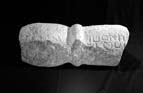
Object type: Inscription on re-used Roman column [1] [2]
Measurements: L. 66 cm (26 in); W. 25 cm (9 in); D. 22 cm (8.5 in)
Stone type: Light grey (N8), medium-grained, clastsupported, shelly limestone with clasts mostly in the range 0.3 to 0.5 mm; some elongate shell fragments up to 10 mm. The majority of the clasts are sub-rounded to rounded, with the well-rounded clasts resembling ooliths; shell fragments make up to about 10% of the rock. Doulting stone, Upper Inferior Oolite Formation, Inferior Oolite Group, Middle Jurassic
Plate numbers in printed volume: Pls. 128-31
Corpus volume reference: Vol 7 p. 119-120
(There may be more views or larger images available for this item. Click on the thumbnail image to view.)
This is part of a colonette or baluster in which the swelling outline is pinched in with a rounded band in the manner of an astragal. It is probably Roman.
Inscription An inscription in two lines incised into a reused architectural fragment (R.C.H.M.(E.) 1970b, 308, no. ii; Radford and Jackson 1970, 311). The right-hand end of both lines has been lost.
IVDN[N . ] —
[F . . .]QVI—
Only the upper parts of the first few letters in the second line remain. Nevertheless, enough remains of the first letter to make its identification as Insular half-uncial F very probable. What is left of the following strokes would fit the reconstruction of the first part of the second line as Latin FILI ('son' in the genitive) (Radford and Jackson 1970, 311). The nominative FILIVS is also a possibility. The first word can be explained as an incomplete Brittonic masculine personal name (Radford and Jackson 1970, 311; Sims-Williams 2003, 129, 192, 234 and n. 1482). Radford and Jackson (1970, 311) take the QVI— as the beginning of a second name. The spelling would exclude a Welsh name but could be either Irish or Latin, although neither would be expected. Sims-Williams (2003, 214, n. 1326) doubts the second I of Radford and Jackson's FILI and raises the possibility that the QVI 'may be the middle not the start of a name'.
The lettering is closer-packed and more regular than that of Wareham 5. It was cut with a U-section and is now worn and damaged. Letters are approximately 3.8 cm high. Radford and Jackson noted forked serifs on a few of the letters. This is uncertain and they can never have been as distinct as those on Wareham 5. The letters are a mixture of forms deriving from Roman capitals (D, I and the first N) and from Insular half-uncial (the probable F, the probable second N, Q and V). (Too little remains of the sixth letter in line 1 to confirm the reading of it as a rounded form of E (Radford and Jackson 1970, 311).) The squarish treatment of Roman D and halfuncial V is distinctive. Radford and Jackson were probably right to see this inscription, with its mixture of Roman and Insular forms and squarish treatment, as contemporary with later examples of Nash-Williams' Group I and earlier examples of his Group II, although 'probably late 7th-century' is an unjustifiably precise dating. Sims-Williams assigns the text of this inscription to his Brittonic period 14–26, which implies a phonological date range between the second half of the sixth century and the middle of the ninth (Sims-Williams 2003, 285, 289, 291, 294–5, 366).
Inscription The inscription on Wareham 6 commemorated an individual with a probably masculine Brittonic first name, and analogies for the lettering can be found amongst Welsh inscriptions. Probably seventh or eighth-century.
[1] The unique collection of sculpture from this site includes some possible Roman stones, as well as five Brittonic inscriptions which have generally been dated between the seventh and ninth century, and thus seem to have been produced within the period of the Anglo-Saxon hegemony. Although these have been included in recent catalogues and discussions of the inscriptions by Celtic specialists (see the Celtic Inscribed Stones Project on-line database and Sims-Williams 2003), they were excluded from Okasha's south-western corpus (Okasha 1993, appendix D). They have therefore been considered in some detail here (see Wareham 5–9 below), and are discussed in John Higgitt's chapter of the introduction, p. 65.
