Select a site alphabetically from the choices shown in the box below. Alternatively, browse sculptural examples using the Forward/Back buttons.
Chapters for this volume, along with copies of original in-text images, are available here.


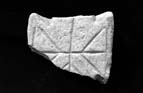
Object type: Part of a cross-headed grave-marker [1]
Measurements: W. 30.5 cm (12 in); H. 25.5 > 15 cm (10 > 6 in); D. 15 > 11.5 cm (6 > 4.5 in)
Stone type: Pinkish grey (5YR 8/1), medium-grained, clast-supported limestone. Clasts in the range 0.4 to 0.6 mm. The majority of the clasts are sub-rounded to rounded, with the well-rounded clasts resembling ooliths; scattered shell fragments up to 3 mm. Doulting stone, Upper Inferior Oolite Formation, Inferior Oolite Group, Middle Jurassic
Plate numbers in printed volume: Pls. 118-21
Corpus volume reference: Vol 7 p. 117
(There may be more views or larger images available for this item. Click on the thumbnail image to view.)
Part of the short wedge-shaped horizontal arms of the cross-head (type B8) survive.
A (broad): The face is edged with a rough moulding and bisected by a single vertical line terminating in a forked cross, and similar incised lines terminating in forked crosses bisect the face horizontally.
B (narrow): A single incision linear cross (type A1)
C (broad): There are no edge mouldings but the face is deeply incised with a linear cross, with cross-shaped terminations for the horizontal arms.
D (narrow): A single incised line
This could be the eleventh-century cross noted by the Royal Commission (R.C.H.M.(E.) 1970b, 309), and the shape of the head, especially if part of a tall cross, could well indicate a late date. Nevertheless the form and the incised ornament have other parallels. If interpreted as a cross-headed grave-marker then it may be considered in relation to stelae from Merovingian graves in the Val d'Oise and Les Yvelines in northern France (Sirat et al. 1984, pl. XLIV). The simple gravemarkers, or plaster coffins, found in this region are often incised with branching lines (ibid., pl. XVII, 95), crossed lines or squares (ibid., pl. XXV, 137). In the light of this, as well as comparable ornament on Wareham 4, and the Brittonic inscriptions discussed below (Wareham 5–9), it is possible to see here a British link with the Gaulish church, as is attested by documentary evidence (see introduction p. 3). In which case a date earlier rather than later in the bracket suggested is possible.
A particularly close parallel is also found in a fragment from West Nappin, Jurby, Isle of Man (Kermode 1907, pl. VII, no. 14), where the context seems to be a native cemetery (see Ill. 540).
