Select a site alphabetically from the choices shown in the box below. Alternatively, browse sculptural examples using the Forward/Back buttons.
Chapters for this volume, along with copies of original in-text images, are available here.


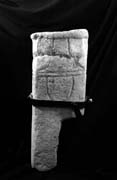
Object type: Columnar fragment [1]
Measurements: H. 64 cm (25 in); W. 25.5 > 23 cm (10 > 9 in); D. 25.5 > 21 cm (10 > 8.25 in)
Stone type: Yellowish grey (5Y 7/2), dominantly medium-grained (0.3 to 0.6 mm), clast-supported, limestone with a few scattered much larger clasts (up to 1 mm). The majority of the clasts are sub-rounded to rounded, with the well-rounded clasts resembling ooliths. Scattered small bivalve fragments up to 4 mm across. Doulting stone, Upper Inferior Oolite Formation, Inferior Oolite Group, Middle Jurassic
Plate numbers in printed volume: Pls. 122-5
Corpus volume reference: Vol 7 p. 117
(There may be more views or larger images available for this item. Click on the thumbnail image to view.)
The shaft is sub-rectangular, plain at the base and capped by a roll moulding. Below this are incised pendant U-shapes or scallops, which, as can be seen most clearly on faces C and D, are neatly centred on similar incised scallops which span the corners.
This is clearly the same type of monument as Wareham 1, although the incised free-hand scallops are difficult to parallel, whether in Britain or France (see discussion below Wareham 1).
