Select a site alphabetically from the choices shown in the box below. Alternatively, browse sculptural examples using the Forward/Back buttons.
Chapters for this volume, along with copies of original in-text images, are available here.


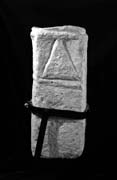
Object type: Columnar fragment [1]
Measurements: H. 53.5 cm (21 in); W. 23 cm (9 in); D. 23 cm (9 in)
Stone type: Yellowish grey (5Y 7/2), dominantly medium-grained (0.3 to 0.6 mm), clast-supported, limestone with a few scattered much larger clasts (up to 1 mm). The majority of the clasts are sub-rounded to rounded, with the well-rounded clasts resembling ooliths. Scattered small bivalve fragments up to 4 mm across. Doulting stone, Upper Inferior Oolite Formation, Inferior Oolite Group, Middle Jurassic
Plate numbers in printed volume: Pls. 114-7
Corpus volume reference: Vol 7 p. 116
(There may be more views or larger images available for this item. Click on the thumbnail image to view.)
Although this is a columnar form it has not been turned, but has been roughly chiselled into a sub-rectangular shape with four distinct faces. The lower section of the shaft is plain and this is surmounted by a decorated capping consisting of obtuse triangles in low relief framed above and below by crude roll mouldings. The top of the shaft is broken away but appears to have had a second moulding.
This and Wareham 2 could have been a pair, or the survivors of a sequence of such 'columns'. They seem to be an attempt to carve columns by a rather unpractised hand. There are various columnar monuments in the south-west (see Yetminster, Ills. 153–9) and this could be a regional tradition which has a long history reaching back to the sub-Roman period. The division between shaft and capping on these two pieces could indicate an architectural tradition if not function, and it is possible that they surrounded an altar or shrine; alternatively they may have been funerary stelae in the same Merovingian tradition as is suggested for Wareham 3 and 4 (see below) or the inscribed rough stelae of British Wales (Nash-Williams 1950, pls. II–X). They can be compared with the Sandwich, Kent, stelae (Tweddle et al. 1995, ills. 151–7), which have been dated fifth to eighth century and are seen by Tweddle as the earliest pieces in the southeast region (ibid., 31, 168–71). The Royal Commission dated Wareham 1 and 2 to the tenth or eleventh century with no supporting evidence (R.C.H.M.(E.) 1970b, 309), but since they are such individual pieces it is difficult to provide them with a good dated context.
