Select a site alphabetically from the choices shown in the box below. Alternatively, browse sculptural examples using the Forward/Back buttons.
Chapters for this volume, along with copies of original in-text images, are available here.


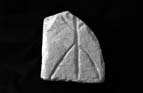
Object type: Block with incised ornament, probably a grave-marker [1]
Measurements: L. 23 cm (9 in); W. 20.5 cm (8 in); D. 15 cm (6 in)
Stone type: Yellowish grey (5Y 7/2), medium-grained, clast-supported limestone. The majority of the clasts are sub-rounded to rounded, with the well-rounded clasts resembling ooliths; clasts range in size mostly from 0.4 to 0.6 mm, with a few up to 1.0 mm. Doulting stone, Upper Inferior Oolite Formation, Inferior Oolite Group, Middle Jurassic
Plate numbers in printed volume: Pls. 126-7
Corpus volume reference: Vol 7 p. 117-8
(There may be more views or larger images available for this item. Click on the thumbnail image to view.)
A (broad): The surface is smoothly finished and deeply incised with a vertical line flanked by two curved branching lines.
B (narrow): Broken
C (broad): Roughly pecked
D (narrow): Smoothly finished and decorated with an incised diamond pattern
E (top): Broken and rounded
F (bottom): Flat
See Wareham 3. The branching linear ornament and the crossed lines forming diamonds can also be found on the stelae and coffins in the same regions as Wareham 3 (Sirat et al. 1984, pl. XXIII, 123, and pl. XXXI, 175). Another interesting parallel for simple stones incised with branching or crossed lines occurs in the British west, in a cemetery context at Cannington, Somerset. Here a roughly triangular stone (no. ST 360), with incised branching and crossed lines as well as a small circular motif, was found with a slab-marked grave-mound in the cemetery (p. 147, Ill. 199), and it is suggested that it could have been a headstone or grave-marker in the general tradition of early Christian memorial stones in western Britain (Rahtz et al. 2000, 263–6, figs. 186, 187). A similar fragment from the site (ibid., no. ST 99, fig. 188) also has branching and crossed lines, and could likewise be a similar monument to Wareham 3 and 4.
In the light of the pecked surface of face C it is possible that this was a recumbent monument.
