Select a site alphabetically from the choices shown in the box below. Alternatively, browse sculptural examples using the Forward/Back buttons.
Chapters for this volume, along with copies of original in-text images, are available here.


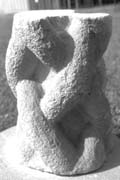
Object type: Decorated column
Measurements: H. 21 cm (8.5 in); W. 15.5 cm (6.25 in); D. 19 cm (7.5 in)
Stone type: Yellowish grey (5Y 8/1), poorly sorted, bioclastic, clast-supported limestone. Clasts vary between sub-angular and sub-rounded, and from 0.4 to 3.0 mm, but mostly fall in the range 0.6 to 1.0 mm. Some clasts broken and show rhomboidal, calcite cleavage. Doulting stone, Upper Inferior Oolite Formation, Inferior Oolite Group, Middle Jurassic
Plate numbers in printed volume: Pls. 368-9
Corpus volume reference: Vol 7 p. 186
(There may be more views or larger images available for this item. Click on the thumbnail image to view.)
This seems to have been an engaged column, with two flat faces forming a V to fit into a corner, and the rounded front face carved with very deep (3 cm) four-strand interlace. The base is probably original, but the square dowel holes at either end are probably secondary. There are traces of gesso.
Appendix A item (stones dating from Saxo-Norman overlap period or of uncertain date).
I can so far find no sculptural parallels for this, but such deeply rounded interlace is found on Romanesque sculptures such as the font base at St Cassian's church, Chaddesley Corbett, Worcestershire (Zarnecki 1953a, fig. 35), and since engaged columns are also a rarity in pre-Conquest contexts, this seems most probably a late piece.
