Select a site alphabetically from the choices shown in the box below. Alternatively, browse sculptural examples using the Forward/Back buttons.
Chapters for this volume, along with copies of original in-text images, are available here.


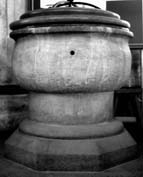
Object type: Font
Measurements: H. 48 cm (19 in); Diam. 75 cm (29.5 in); Total height: 73 cm (28.5 in)
Stone type: The main body of the font consists of a pale grey (N7), bioclastic, clast-supported, limestone. The clasts vary from sub-rounded to rounded and fairly well graded between 0.6 and 1.5 mm, with a few elongate clasts up to 2 mm long. The well-rounded clasts resemble ooliths. There is a neat, wedge-shaped, insert of similar, but pale brown (5YR 5/2) limestone 6.5 cm wide at the top. The rim is a separate piece of stone, but darker, slightly yellowish brown and with a much more polished, weathered patina; it has a slightly higher content of elongate clasts. The base is very heavily patinated. It is more even grained and slightly darker, but nevertheless appears to be the same material. Vertical, pale-coloured marks up to 2 cm wide appear to be surface discolouration rather than infilled joints. Doulting stone, Upper Inferior Oolite Formation, Inferior Oolite Group, Middle Jurassic
Plate numbers in printed volume: Pl.373
Corpus volume reference: Vol 7 p. 186
(There may be more views or larger images available for this item. Click on the thumbnail image to view.)
The font is bowl-shaped with an everted rim, and is a pedestal type, carved with a single columnar support on a rounded base. Part of the rim and the base may be original. Drainage holes on three sides have been blocked by the later lead lining.
Appendix A item (stones dating from Saxo-Norman overlap period or of uncertain date).
Such plain fonts are very difficult to date, and this is of a different shape from other pre-Conquest fonts in the west such as Potterne and Deerhurst (Ills. 472–84; Bailey 2005, pl. 6). The rather flattened and bulbous bowl is however unlike the shallower, more open bowls of a type of Romanesque font (Bond 1908, 52–6, figs.). It is of the same type however as Little Billing, Northamptonshire (ibid., 38, fig.), which seems to be of eleventh-century date (Okasha 1971, 97–8). This piece could then be eleventh century and possibly pre-Conquest.
