Select a site alphabetically from the choices shown in the box below. Alternatively, browse sculptural examples using the Forward/Back buttons.
Chapters for this volume, along with copies of original in-text images, are available here.


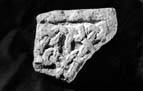
Object type: Top of a cross-shaft(?)
Measurements: H. max. 21 cm (8.25 in); W. max. 25.5 cm (10 in); D. max. 15.2 cm (6 in)
Stone type: Very light grey (N8), poorly sorted, matrixsupported, shelly oolite. Ooliths, which weather out to give 'aero-chocolate' texture, vary from 0.3 to 0.9 mm diameter, but mostly are in the range 0.4 to 0.6 mm. Abraded shell fragments up to 10 mm across occur. Bath stone, Chalfield Oolite Formation, Great Oolite Group, Middle Jurassic
Plate numbers in printed volume: Pls. 101-3
Corpus volume reference: Vol 7 p. 113
(There may be more views or larger images available for this item. Click on the thumbnail image to view.)
A (broad): A broad flat band encloses on one side and top a panel of median-incised interlace (strand width 2 cm). Mortar on face, possibly gesso background.
B (narrow): Part of a flat-band moulding and incised line survive.
C (broad): Broken but section of dowel hole could indicate where the head of a cross had been attached.
D (narrow): Broken
E (top): Dressed smooth and mortar covered
One cannot be sure of the orientation of this piece, and it is therefore possible to see height as width. The cutting is very deep, up to 1 cm, strands are smoothly dressed, and it has the precision and depth of carving of Shaftesbury Abbey 6 or Gillingham 1 (Ills. 96, 67). It could have been the top of an important monument.
