Select a site alphabetically from the choices shown in the box below. Alternatively, browse sculptural examples using the Forward/Back buttons.
Chapters for this volume, along with copies of original in-text images, are available here.


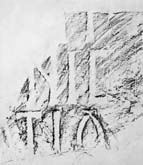
Object type: Lost inscription
Measurements:
(of fragment based on illustrations of the missing rubbing)
(i) H. c. 12 cm (5 in); W. c. 11.5 cm (4.5 in); D. c. 7 cm (2.75 in)
Dimensions estimated from rubbing using Webb's measurement of the letter height (1.75 in).
(ii) H. c. 14 cm (5.5 in); W. c. 13 cm (5.25 in); D. c. 7 cm (2.75 in)
Dimensions estimated from rubbing using R.C.H.M.(E.)'s measurement of the letter height (2 in).
Stone type: [ 'Marble', possibly Purbeck marble]
Plate numbers in printed volume: Pl. 99
Corpus volume reference: Vol 7 p. 111-2
(There may be more views or larger images available for this item. Click on the thumbnail image to view.)
Inscription In his Gesta Pontificum Anglorum, William of Malmesbury (1870, 186; 2002a, 124) recorded an old inscription, which he probably saw in the 1120s. It was then in the chapter house of the nunnery at Shaftesbury and had been brought there from an ancient and ruined wall. William's reading or paraphrase of the inscription is given in the Rolls Series edition as: 'Anno Dominicæ incarnationis Elfredus rex fecit hanc urbem .DCCC. octogesimo, regni sui .viiiVo.' This can be translated as: 'King Alfred built this city (or 'fortress') in the 880th year of the Lord's incarnation and 8th of his own reign.' Urbs can mean 'fortress' or 'castle' as well as 'city' (Niermeyer 1976, 1052). The eighth year of Alfred's reign was in fact 878–9, but as Keynes and Lapidge (1983, 340, n. 6) point out, William could have misread viiii as viii.
Writing some time around 1540, John Leland (Hearne 1744, 104; Smith 1910, 110–11) referred to William's account of the inscription. Whilst Leland seems not to have seen the inscription himself, he adds, although it is not clear on what authority, both that the inscription was formerly 'on the right hond enteringe of the chapiter howse' and that it 'stodd in the waulle of S. Marie's Chapell at the townes end', with the comment that 'The chapel is now pullid downe'. This may mean that it had been moved from the chapter house, where Leland knew that William had seen it, to the east (town-facing) wall of the fourteenth-century chapel, probably a Lady Chapel, just to the north of the chapter house (R.C.H.M.(E.) 1972, 59 and plan facing p. 58).
William's account was again recalled when a piece of inscribed 'marble', possibly Purbeck marble, was found, during excavations in 1904, on the floor of a building, probably the chapter house, just to the south of the south transept of the abbey church (Webb 1904, 4–5). Webb and, more recently, the Royal Commission on Historical Monuments (England) (1972, 57) identified this stone as a fragment of the inscription described by William. In Okasha's view (1983, 98), however, the evidence is not strong enough to prove the identification conclusively.
The inscribed fragment has been lost, but a rubbing of the inscription formerly in the Shaftesbury Historical Museum has been published (R.C.H.M.(E.) 1972, pl. 58; Okasha 1983, pl. Xa). This shows that the fragment came from the right-hand side of an inscription with traces of three lines of lettering. The height of the complete letters has been given as 1? inches and 2 inches (Webb 1904, 4; R.C.H.M.(E.) 1972, 57), that is around 4.5 to 5 cm.
These can be transcribed as follows:
— [ . :]
— [N]IC
— [ATIO]
The two verticals at the end of the first line on the rubbing have been read as M (Webb 1904, 4) and as IT (R.C.H.M.(E.) 1972, 57), both of which are possible. The next two lines are compatible with William's 'Anno Dominicæ incarnationis'. In the context the identification with his inscription is very plausible. If this is accepted, the line ending in —[A]TIO must have contained abouteleven letters. The previous line (the middle line of the fragment) could therefore easily have accommodated the first part of the phrase ([ANNO DOMI]NIC). Lines 2 and 3 of the fragment can reasonably be reconstructed as: [ANNO DOMI]NIC | [æ INCARNA]TIO | [NIS]. As there was at least one line above the —NIC, the inscription is unlikely to have begun with the word ANNO, as reported by William. William's text should in that case be taken as a paraphrase, or extract, rather than an exact transcription. The rubbing seems to show a mid-line point at the end of line 1, either to mark the division between words or, more probably, as a form of punctuation to mark the end of a section of text.
An examination of the rubbing shows that the inscription was neatly laid out in close-packed and regular lines of lettering. A thin vertical line down the righthand edge of the rubbing may indicate that the inscribed area was framed with some sort of incised or moulded border. The letters were said by Webb (1904, 4) to have been 'one and three-quarter inches', that is letters about 4.4 cm high. The Royal Commission on Historical Monuments (England) (1972, 57) gave the height as 2 in (5 cm), but this measurement must have been based on the rubbing since the stone had by then already been lost.
The letters shown in the rubbing have unusually broad strokes for incised lettering and the strokes are finished off with 'stem thickening' (Okasha 1964–8, 332) rather than more usual forms of serifing. The most likely explanation is that the letter strokes were cut as flatbottomed troughs rather than with a V-section. The Shaftesbury inscription would in that case have resembled the eleventh-century, or earlier, inscribed fragment found in excavations in Lower Brook Street, Winchester (Okasha 1983, 102–3, pl. XIIc; Tweddle et al. 1995, 331–3, ill. 678). The Winchester lettering was perhaps cut to take some form of inlay, as suggested in Tweddle et al. (1995, 331–3), and the same may have been true of the Shaftesbury inscription.
The letters that can be seen in the rubbing were noticeably narrow versions of capitals and all can be paralleled in pre-Conquest inscriptions. The fragmentary A in line 3 seems to have been capital in form, to judge from traces of its right-hand diagonal. There is also a possible indication of a head-bar. The rectangular C and the N, the diagonal of which meets the verticals short of their ends, are both common early medieval variants on the 'Roman' form. The O in line 3 is pointed or 'lentoid', a form that can be found in a few, mostly early, Northumbrian inscriptions: at Jarrow, Skelton, Thornhill, Wensley and York (Okasha 1971, nos. 63, 110, 116, 120, 150; Higgitt 1979, 360, pl. LXIIa; Lang 1991, 64, ill. 86; Lang 2001, 224, ill. 883). The I and T are standard capital forms.
The variants of 'Roman' capitals (rectangular C, nonclassical N and lentoid O), can all be found in the display script of some southern English manuscripts of the second half of the tenth or earlier eleventh century, although the classical form of N is more usual (R.C.H.M.(E.) 1972, 57; Temple 1976, ills. 54, 57, 83, 138; Backhouse et al. 1984, pl. V and plate on 150). The broad strokes, the 'stem thickening' treatment of terminals and the tendency to narrow proportions, which can be seen in the Shaftesbury rubbing, also find parallels in the display script of a number of books of this period (Temple 1976, ills. 75, 83; Backhouse et al. 1984, pl. V and plate on 48).
The epigraphic and manuscript parallels support but do not prove a pre-Conquest dating for the lettering recorded in the rubbing, most probably one in the later tenth or earlier eleventh century (cf. R.C.H.M.(E.) 1972, 57). An earlier dating to the time of Alfred or shortly after should not be excluded, however, given the early epigraphic parallels for the C, N and O and the occurrence of 'stem thickening' in English lettering in various media from the eighth century onwards (Higgitt 1990, 35–6).
Hearne 1744, 104; Gough 1806, I, 62, 72; William of Malmesbury (ed. Hamilton) 1870, 186; Webb 1904, 4–5; Smith 1910, 110–11; Clapham 1947d, 163; Sydenham 1953, 8–9, 40; Sydenham 1959, 1; Radford 1970, 87; R.C.H.M.(E.) 1972, 56, 57, fig. on 57, pl. 58; Brown 1982, 15; Okasha 1983, 98, no. 175, pl. Xa; Brown 1989, 233; Higgitt 1990, 36; Higgitt 2002, 256–7; William of Malmesbury (ed. Preest) 2002a, 124; Higgitt 2004, 9; Okasha 2004, 278
