Select a site alphabetically from the choices shown in the box below. Alternatively, browse sculptural examples using the Forward/Back buttons.
Chapters for this volume, along with copies of original in-text images, are available here.


Object type: Architectural fragment
Measurements: L. 48 cm (19 in); W. 34 cm (13.5 in); D. 14 < 18 cm (5.5 < 7 in)
Stone type: Yellowish grey (5Y8/1), fine-grained, ?clast supported, very sandy limestone. The sub-angular to subrounded quartz clasts are between 0.1 and 0.2 mm across. There is a scatter of very small dark (?glauconite) grains. A few moulds of bivalves up to 15 mm across (one recognisable as Laevitrigonia) and a few elongate bivalves with shells up to 8 mm. This stone is almost identical to the Chicksgrove 'B' bed currently worked as a building stone at Chicksgrove Quarry, near Tisbury. Tisbury/Chilmark stone, Tisbury Member, Portland Stone Formation, Portland Group of the Vale of Wardour, Upper Jurassic
Plate numbers in printed volume: Pls. 97-8
Corpus volume reference: Vol 7 p. 110-1
(There may be more views or larger images available for this item. Click on the thumbnail image to view.)
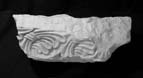
One carved face survives with a crisplycut acanthus scroll.
This could be part of an impost, and its very fresh condition contrasts markedly with the plant-scrolls on exterior cross-shafts, such as Todber (Ills. 104–13), with which this has some affinity. Such crisply curled leaves can be found on a fragment of a grave-slab from St Oswald's, Gloucester (Heighway and Bryant 1999, 168, no. 40, fig. 4.18) which has been dated to the tenth century. Such well carved and up to date foliage ornament would have been suitable for the royal abbey at Shaftesbury (see introduction pp. 8, 9).
