Select a site alphabetically from the choices shown in the box below. Alternatively, browse sculptural examples using the Forward/Back buttons.
Chapters for this volume, along with copies of original in-text images, are available here.


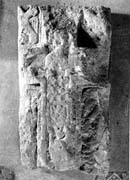
Object type: Flat rectangular grave-cover [1]
Measurements: L. 64 cm (25.5 in); W. 35.5 cm (14 in); D. 16.5 cm (6.5 in) at centre, including cross; 12.5 cm (5 in) at lower level
Stone type: Pale brownish yellow (10YR 8/4) oolitic limestone with 0.5mm ooliths (range 0.4 to 0.6mm), some 2mm pellets, and worn shell fragments; no discernible bedding. Bath stone
Plate numbers in printed volume: Pls. 509-10
Corpus volume reference: Vol 7 p. 232-3
(There may be more views or larger images available for this item. Click on the thumbnail image to view.)
A (top): In the centre is a cross (type A1) deeply raised from the background and at its centre is an Agnus Dei. It is shown in a crouching position, with its head (showing traces of a halo) held up and extending into the upper arm. Its front leg is extended, and the back leg tucked under its body. It perches on a panel with scallops which seem to be the conventional depiction of rocky ground; below that on the shaft is a panel of close-packed interlace, and below that there appears to be a figure either with upstretched arms or with wings. On the lower level flanking the cross only one panel (upper left) is decipherable; this is a winged creature, possibly a lion. The panel below is almost obliterated but may show the foot and part of the body of a crouching beast. On the opposite side of the shaft is a serpentine creature with a double-outlined body and with canine head turned back and biting its body. Its tongue extends and penetrates the body.
This seems to be the apocalyptic Lamb, possibly surrounded by the symbols of the Evangelists, as described in Revelation 5. 6, 12, 13, rather than the sacrificial Agnus Dei of the mass which occurs in a solitary form in earlier contexts, such as the cross-head at Hoddom (Collingwood 1927, fig. 51), or as a later type with the symbols of the passion and eucharist which becomes very popular in Carolingian art — see for example the ninth-century Tours manuscripts, the Gospels of St Gauzelin and the Bamberg Bible (Hubert et al. 1970, ills. 120 and 121). As Raw has noted however, 'the lamb belongs to that field of symbolism where crucifixion imagery and apocalypse imagery overlap: the lamb who is worthy of honour and dominion, and who stands on the throne among the four beasts (Apocalypse V, 6, 12) is also the lamb who is the sacrifice' (Raw 1967, 391), and this common practice of scriptural crossreferencing in early medieval art has been further developed by Jennifer O'Reilly (Okasha and O'Reilly 1984, 40–1).
On Anglo-Saxon sculptures the solitary type of image, which could be apocalyptic, is found on a cross-head from Hart, co. Durham, where the Lamb stands in the centre of the head surrounded by Evangelist symbols in each arm, which are haloed, multi-winged and holding books (Cramp 1984, 95, pl. 82, 417). On the coped slab at Wirksworth, Derbyshire, the rather crude carving is a better parallel for Ramsbury, since the Lamb is crouched in the centre of a cross, with the symbols in the spandrels of the arms. This has most recently been considered in depth by Jane Hawkes, who has compared the crouching Lamb with the Lamb lying on the throne set in heaven (Revelation 4. 2) on the sixth-century apse mosaic of SS. Cosmas and Damien, Rome (Hawkes 1995, 250, fig. 5; cf. Schiller 1971, pl. 594). Another parallel of similar date in which the crouching Lamb is shown alone in a medallion is to be found in the centre of the soffit of an arch mosaic from S. Michele in Affricisco, Ravenna, now in the Kaiser Friedrich Museum, Berlin (Morey 1953, fig. 184). This last is more like the slumped Wirksworth creature (which could invoke also the slain Lamb of the Exodus passover), in contrast to the crouching creature with upright head shown at Ramsbury and in the Rome mosaic. It is noteworthy though that the scallops or 'rocky ground' on which the Ramsbury Lamb is crouching is more a feature of the early standing type.
Although the arrangement of symbols around the Lamb normally follows the order in Revelation 4. 6–8, there is considerable variation in late Anglo-Saxon art (Okasha and O'Reilly 1984, 41–4), so that it is impossible to be certain how they were placed at Ramsbury. Indeed it is not clear either where they were placed: the winged lion on the top left could indicate that the creatures were in the spandrels of the cross-arms, as at Wirksworth, but in that case it is difficult to fit in the long panels flanking the shaft, the one on the right of which is clearly interlaced serpentine beasts. If however the symbols were on the cross itself, at the ends of the arms where the surface has been chopped back, then it is possible that the eagle or man was on the upper arm, the winged man or eagle on the lower beneath the panel of interlace, and the lion and calf on the panels on either side of the cross-head — an arrangement such as one finds on a Durham crosshead (Cramp 1984, 68–9, pl. 43, 205). Coatsworth has suggested that the winged figure below the cross might be an angel or one of the twenty-four elders who can accompany apocalyptic scenes (Coatsworth 1979, I, 59). This last seems an unlikely interpretation of a single figure. It is not uncommon to find Evangelist symbols interspersed with decorative animal and plant ornament, as on an eleventh-century ivory reliquary cross in the Victoria and Albert Museum (Raw 1967, pl. 45a–c), so that the animals on either side of the shaft would not be out of place. The Lamb on the Durham cross-head, like those on coinage and brooches of the early eleventh century, is shown in an active pose with a cross behind it, and touching a book (presumably the book with seven seals) with its foot (see Dolley 1971, pl. VIIIa–d). Neither the cross nor the book is apparent on this depiction, and therefore it is not so clearly associated with the Last Judgement. Perhaps then the Lamb at Ramsbury is nearer in type to the earlier depictions such as Hart where the Lamb occurs in isolation, although surrounded by the beasts whose primary significance could be as symbols of the Evangelists.
The Ramsbury carving could then be as eclectic in its iconography as has been postulated for the Wirksworth slab, where Hawkes considered that the scene may be 'a composite of details which were circulating in the West between the sixth and eighth centuries' (1995, 251–2). Despite the several parallels with eleventh-century art, from the iconography alone it is not possible to suggest a firm date for this very damaged slab, and it is unfortunate that so little remains of the detail in contrast with the more simply decorated coped grave-covers. Certainly it is the only piece from the Ramsbury collection which reflects its importance as an episcopal site, and an awareness of the theological and liturgical themes which are so fully expressed in the literature of later Anglo- Saxon England. Since the Lamb of the Apocalypse can be cross-referenced with the Eucharistic sacrifice, but also represents not Christ alone but his Church (Hawkes 1995, 265), this would be suitable iconography on a grave-cover for a bishop, or high ranking ecclesiastic.
