Select a site alphabetically from the choices shown in the box below. Alternatively, browse sculptural examples using the Forward/Back buttons.
Chapters for this volume, along with copies of original in-text images, are available here.


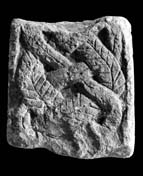
Object type: Fragment of small cross-shaft [1]
Measurements: H. 25.5 cm (10 in); W. 23 > 21.5 cm (9 > 8.5 in); D. 13 > 11.5 cm (5 > 4.5 in)
Stone type: Pale yellowish grey (10YR 8/2) evenly graded oolitic limestone with a calcite matrix containing closely-set 0.4 to 0.5mm ooliths, shown by vacated sockets. Bath stone
Plate numbers in printed volume: Pls. 511-14
Corpus volume reference: Vol 7 p. 233
(There may be more views or larger images available for this item. Click on the thumbnail image to view.)
A (broad): Part of a panel surrounded by a rounded and incised moulding. Two reptilian animals interlace. Their bodies are textured with boldly incised herringbone, and these are interlaced with narrower features, which could be their tails, having a single central groove.
B (narrow): One edge moulding with diagonal incisions which could represent and attempt to convey a cabled edge. Parts of what could be two reptilian creatures are enmeshed. One body is textured with a central row of pellets, and the other is median-incised.
C (broad): Back chiselled away
D (narrow): This face is covered with mortar but there are faint impressions of curving bands, which could be reptilian bodies.
There is not the same clear division here between interlace and reptilian bodies as there is in Ramsbury 2 and 3, and it is difficult to decide how many animals are involved on faces A and B. On the whole it would appear to be a crude rendering of the reptiles on Ramsbury 3, and by another hand. One should remember though that close-meshed animals with such simple herringbone or pellet decoration are the ones most commonly found, for example at Colyton, Chew Stoke, and Wells (Ills. 7, 200, 325).
