Select a site alphabetically from the choices shown in the box below. Alternatively, browse sculptural examples using the Forward/Back buttons.
Chapters for this volume, along with copies of original in-text images, are available here.


Object type: Part of a round-ended coped grave-cover [1]
Measurements:
L. 116 cm (45.5 in); W. 46 cm (18 in)
D. 13.5 cm (5.25 in) (possibly 2.25 inches built in since Goddard said 7.5 inches deep)
Stone type: As Ramsbury 4, oolite with a calcite matrix containing 0.4 to 0.5mm ooliths, pellets and shell fragments; texture apparently disordered. Bath stone
Plate numbers in printed volume: Pls. 506-7
Corpus volume reference: Vol 7 p. 231
(There may be more views or larger images available for this item. Click on the thumbnail image to view.)
This is a round-ended grave-cover, with a domed top rising from a flanged base and tapering towards the rounded end.
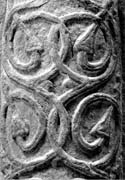
A (top): The top of the cover is entirely covered with a twisted plant-scroll. The stem of the plant springs from a single stepped base, with a pair of small leaf coils on either side, and then branches into parallel strands which form four paired volutes. At the intersections of each pair are short rounded leaves, and each volute terminates in a long triangular leaf with a sunken centre and with the tips prolonged into what might be seen as a second leaf or flower. The curling strands from which the leaves sprout are median-incised, and each leaf is outlined to emphasise its triangular shape.
This shape of grave-cover — which is identical with Ramsbury 4 — is not common (see above), and despite the difference in ornament it must be near in date to Ramsbury 4, its closest formal parallel. The bold scrolls are more arid and stylised than, for example, the plant forms on East Stour, Dorset (Ills. 57–64), but the technique is confident and the details are quite subtle as the leaves pass over and under the stems. These scrolls have been compared with Edenham 1 in Lincolnshire (Everson and Stocker 1999, 159), and interlaced leafscrolls combined with rounded buds also occur on brooches such as the earliest of the Pentney hoard (Webster and Backhouse 1991, 229–310, ill. 187f); indeed they seem to be a period form, which in metalwork and manuscripts is dated to the ninth to tenth centuries.
