Select a site alphabetically from the choices shown in the box below. Alternatively, browse sculptural examples using the Forward/Back buttons.
Chapters for this volume, along with copies of original in-text images, are available here.


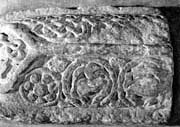
Object type: Part of a round-ended coped grave-cover [1]
Measurements: L. 73 cm (28.75 in); W. 47 cm (18.5 in); D. 15.2 cm (6 in) (possibly 1 inch built in since Goddard said 7 inches deep)
Stone type: Oolitic limestone with a calcite matrix containing ooliths of 0.4 to 0.5mm diameter and many pellets and shell fragments, the latter strewn in a disordered fashion on the exposed surface of the stone, which is probably a bedding plane. Bath stone
Plate numbers in printed volume: Pls. 503-5; 508
Corpus volume reference: Vol 7 p. 230-1
(There may be more views or larger images available for this item. Click on the thumbnail image to view.)
A (top): The grave-cover has a flat flange surrounding a domed top which is divided by a broad band. This diverges at the rounded end to form a sort of gable, and terminates in two canine heads whose tongues join in an interlace knot, type E. On the north side are a pair of crouching animals. Their heads, supported on long narrow necks, are bent back to bite their tails. One has a canine head, the other is more bird-like. Each creature is enclosed in a plain roundel, and in the spandrels are five-petalled rosettes with scooped leaves. Towards the rounded end of the cover is a smaller roundel enclosing a bold seven-petalled rosette. On the south side is a panel which originally had two rows of figure-of-eight (pattern F) knots, but two registers of those nearest the ridge have been worn or chipped away.
Although the interlace strands are not median-incised as on Ramsbury 1, the identity of the pattern, combined with the same type of animal which is enclosed in roundels divided by rosettes, means that Ramsbury 1 and 4 must surely be contemporaneous, probably a suite with the cross at the head of a grave and the slab covering it. They may even be by the same hand.
This type of grave-cover is uncommon in Anglo-Saxon England, and save for Ramsbury 5 there is only one close formal parallel, a cover from Repton in Derbyshire (Tweddle 1991c, 246–7, ill. 212). This does not have the flanged base and is differently ornamented, but it does have the slightly tapering form with one round and one apparently square-cut end. Tweddle has interestingly suggested that, despite the fact that the ornament seems to be cut off (as also on the Ramsbury pieces), the square end may be original and butted against a headstone. This view gains support from a grave-cover in Durham Cathedral, which also has a flanged base and domed top which is curved at one end and squared at the other, but here the ornament at the squared end is complete and enclosed in a roll moulding (Cramp 1984, pls. 49, 234–5; 50, 236). The Durham piece can hardly be earlier than the late tenth century (ibid., 73), but the form could have existed earlier, and the undamaged state of the Durham piece suggests that the Ramsbury and Repton covers may have had squared-off ends, but that the ornament would have been completed. In the case of this Ramsbury cover, it is reasonable to suppose that it was butted against the base of Ramsbury 1, with which it is so closely linked ornamentally.
