Select a site alphabetically from the choices shown in the box below. Alternatively, browse sculptural examples using the Forward/Back buttons.
Chapters for this volume, along with copies of original in-text images, are available here.


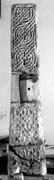
Object type: Base of cross-shaft [1]
Measurements: H. 91.5 cm (36 in); W. 51 > 45 cm (20.5 > 17.75 in); D. 47 > 40.5 cm (18.5 > 16 in)
Stone type: As Ramsbury 2, oolite with a calcite matrix and closely-set ooliths of 0.3 to 0.5mm diameter. Bath stone
Plate numbers in printed volume: Pls. 485-7; 495-502
Corpus volume reference: Vol 7 p. 230
(There may be more views or larger images available for this item. Click on the thumbnail image to view.)
Complete panels surrounded by fragmentary flat-band mouldings chiselled away at the base.
A (broad): One complete serpentine beast enmeshed in irregular loops of median-incised interlace. Its body is contoured and decorated with incised chevron patterns. The body coils from the tail at the base, and its head at the top penetrates the body. The head, viewed from above, is divided by single chevrons and has two sharply drilled eyes.
B (narrow): One complete reptilian animal; its body coils from a thin tail which is a strand of interlace and broadens into a loop, terminating in a snub-nosed head shown in profile biting its own body with sharp teeth. Its eye is sharply drilled and back-pointed, and its body is decorated with a single row of chevrons where narrow and a double row as it widens. The body is tightly fettered with loops and knots of median-incised interlace, which terminates at the top with two pattern E knots, and between the coil with lobed tendril-like ends.
C (broad): Rows of three turned pattern C knots repeated in five registers, the top terminating in small pattern E knots.
D (narrow): Four registers of pairs of turned pattern C knots with median-incised strands.
This piece and Ramsbury 2 belong to the ribbonanimal group which is discussed in the introduction, p. 42. Its interlace types are identical with those from Dolton in Devon (Ill. 22), but these reptilian animals on faces A and B are very different from the beasts on that cross, and indeed from any others, although the animals on the shaft from Tenbury Wells, Worcestershire, are the closest both in composition and body patterning (Tweddle et al. 1995, fig. 10c–e; see Ill. 547). The composition is full of writhing life, and the savage biting at their own bodies, as well as the fetters and chains with which they are tightly bound, give these creatures a demonic appearance. If one is to see a religious significance in these panels then it must surely be as evil forces bound.
