Volume 7: South West England
Select a site alphabetically from the choices shown in the box below. Alternatively, browse sculptural examples using the Forward/Back buttons.
Chapters for this volume, along with copies of original in-text images, are available here.
Current Display: Ramsbury 2, Wiltshire


Overview
Object type: Part of cross-shaft [1]
Measurements: H. 33.5 cm (13.25 in); W. 44.5 > 40 cm (17.5 > 15.75 in); D. 26 cm (10.25 in) (joined to newer stone)
Stone type: Oolitic limestone with a calcite matrix including closely-set oooliths of 0.3 to 0.5mm diameter and many 3 to 4mm shell fragments. Traces of bedding aligned vertically on the north side of the fragment. Bath stone
Plate numbers in printed volume: Pls. 485-7; 492-4
Corpus volume reference: Vol 7 p. 229-30
(There may be more views or larger images available for this item. Click on the thumbnail image to view.)
Present Location
Platform at west end of north aisle, in centre of column with nos. 1 and 3
Evidence for Discovery
See Ramsbury 1.
Church Dedication
Holy Cross
Present Condition
Very worn on face A, redressed on other faces
Description
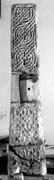
A (broad): Part of two reptilian creatures with bodies outlined and incised with double chevrons, enmeshed in loops of interlace with median-incised strands. One head is at the base, the other at the top left. Both have sharply drilled eyes.
B (narrow): Chiselled away
C (broad): Hidden in block
D (narrow): Re-dressed with a hole in the centre
Discussion
This seems most likely part of the lower broken shaft (Ramsbury 3), but Plunkett has considered that this is not so and that it should be seen as a separate monument built in on its side, and that the hole on face D should be seen as in its base (Plunkett 1984, II, 283). The hole however could be secondary and a feature of its recutting, and despite the fact that it does not join with the shaft below, its detail and cutting are so close to Ramsbury 3 that they must surely be part of the same monument. For further discussion see Ramsbury 3 below (p. 230).
Date
Ninth / tenth century
References
(––––) 1891; Stewart 1891, 98, fig. 2; Allen 1894, 63, 64, pl. (C) facing 52; Goddard 1894, 44–5; Browne 1903, 155–6; Brøndsted 1924, 126; Clapham 1930, 127, pl. 54; Cottrill 1931, 30–1, 36, fig. 8; Cottrill 1935, 149, 151; Brown 1937, 94, 283, 285, 286, pl. CXII; Kendrick 1938, 211–12, pl. C; Rice 1952, 127, 137–8; Stone 1955b, 38; Fisher 1959, 80, pl. 36a; Wilson and Klindt-Jensen 1966, 106; Pevsner and Cherry 1975, 377–8; Plunkett 1984, I, 182, 190, 194, II, 283, 305, 363, no. V, pl. 73; Wilson 1984, 108, 146, ill. 135; Graham-Campbell 1987, 150; Tweddle et al. 1995, 37–8, fig. 11f; Bailey 1996, 20–1; Croucher 2005, 6, ill. (b)
Endnotes
[1] The following are general references to the Ramsbury stones: (––––) 1891; Baber 1891; Stewart 1891, 94; (––––) 1893–4, 120, and fig.; Browne 1894, 275; Goddard 1894, 49; Webb 1894, 90–1, and pl.; (––––) 1902a, 237, ill. on 239; Browne 1903, 155–8; Browne 1906, 247–9, pl. 3; Peers 1926, 53; Collingwood 1927, 183; Clapham 1930, 127, 129; Cottrill 1931, 29–30; Gardner 1951, 42; Stone 1955b, 37, 38; Pevsner 1963, 15, 332; Taylor 1963, 169; Taylor and Taylor 1963b, 249; Jope 1964, 99, 104; Taylor and Taylor 1965, II, 502–3; Pevsner and Cherry 1975, 17; Cramp 1978, 11; Ball 1979, 38; Cramp 1980, 7; Haslam 1980, 1; Tweddle 1983, 18; R.C.H.M.(E.) 1987, 12; Tweddle 1991a, 239, 242; Cramp 1992, 151, 155, 228, 264; Tweddle 1992, 1147; Hicks 1993, 205; Cramp 2001, 158; Croucher 2005, 2, 6–8, 43, 64, 73.