Select a site alphabetically from the choices shown in the box below. Alternatively, browse sculptural examples using the Forward/Back buttons.
Chapters for this volume, along with copies of original in-text images, are available here.


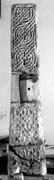
Object type: Cross-shaft [1]
Measurements: H. 89 cm (35 in); W. 38 > 35 cm (15 > 13.75 in); D. 33 > 28 cm (13 > 11.5 in)
Stone type: Oolitic limestone comprising ooliths of 0.4 to 0.6mm diameter, many pellets, and shell fragments up to 4mm across. Bedding shown by vertical parallel streaks of shell fragments on the south side (as erected) of the fragment. In its laminated shelly texture the stone resembles that of Littleton Drew 1a and 1b (p. 221). Bath stone, Chalfield Oolite Formation, Great Oolite Group, Middle Jurassic
Plate numbers in printed volume: Pls. 485-7; 488-91
Corpus volume reference: Vol 7 p. 228-9
(There may be more views or larger images available for this item. Click on the thumbnail image to view.)
Each face is surrounded by a flat-band moulding and is therefore one complete panel.
A (broad): One half and two full roundels enclose crouching canine-like quadrupeds. Their bodies are curiously shaped, like leaves, with front legs bent like stalks and terminating in three pointed toes. Each back leg is also leaf-shaped. The tails end in a triangular lobed leaf and are gripped in the jaws of the backward-turned head. The blunt muzzled heads are seen in profile, but both ears are shown as though seen from above. Filling the spaces between the two upper roundels are four fivepelleted rosettes; at the base are two heavy pellets.
B (narrow): Four pairs of figure-of-eight knots (simple pattern F) and a joined terminal; each knot about 19 cm (7.5 in) high, with median-incised strands. A secondary hole 10 cm (4 in) deep, and the western base chiselled away.
C (broad): One complete and one partial roundel survive, enclosing quadrupeds with the same body type as on face A but with heads hanging down. The heads are shown frontally with two rounded ears and lightly incised lentoid eyes, and the creatures' leafy tails penetrate the back of their necks. They have three-clawed feet. Filling the spaces between the roundels are the remains of three five-petalled rosettes. The base of the panel has been chiselled away.
D (narrow): Three closed-circuit interlace-related motifs, in which six crossing strands interlink diagonally through three rings, but are turned in the centre of each motif to form a loop with two of the strands, and with the other crossing in the centre. The strands are rounded and about 2.5 cm (1 in) wide. There is a secondary hole cutting the lowest motif.
E (top): There are four dowel holes about 11 cm (4.5 in) deep.
This is a competently carved piece, possibly the lower panel of a shaft to which an upper part (now lost) has been dowelled. It is not part of the same monument as Ramsbury 2 and 3, as earlier commentators even as late as Kendrick (1938, 212) supposed. The paired figure-of-eight motifs are commonplace not only in Wessex (compare Colyton and Dolton: Ills. 6, 20, 22) but throughout Anglo-Saxon England (see Everson and Stocker 1999, fig. 14). Nevertheless this pattern seems to gain popularity after the end of the eighth century and may indeed have been originally inspired by Mediterranean models, as Kendrick suggested, as he did also for the clever pattern on face D (1938, 212). This is a unique pattern on surviving Anglo-Saxon sculpture, although a simpler form of circles interlinked by crossing strands is found on Wantage 1A, Berkshire (Tweddle et al. 1995, 268, ill. 474).
Even more unusual are the fantastic leonine creatures on the broader faces. Animals with backturned heads which bite their own leafy tails have a long history in European art: for example in the Gelasian Sacramentary (c. 750), Vatican MS Reg. Lat. 316, fol. 4r (Hubert et al. 1969, ill. 175), or in the Vespasian Psalter (Alexander 1978, ill. 146), both of which have been seen as influenced by Coptic and Near Eastern art. (The loose rosettes are also a motif found in these manuscripts.) But this need not mean that this cross is contemporary in date, although some sort of inspiration apart from the inhabited vinescroll seems apparent. As noted above, the creatures' bodies are leaf-shaped, or as Kendrick put it, 'they are phantasies that are half-animal and half-scroll' (Kendrick 1938, 213). They are playfully varied in stance, from face to face and also on the coped grave-cover Ramsbury 4 which probably lay at the foot of this shaft (Ill. 503; see below, p. 231). Their singularity could point to a misunderstanding of certain features such as the leg joints when copying the animal silhouettes of manuscripts, or could be an attempt at novelty. Certainly they remain without close parallel in sculpture, although the heads can be paralleled at Godalming, Surrey, which is dated by Tweddle ninth century (Tweddle et al. 1995, 145, ills. 87–90). Also closely allied are the backward-biting beasts which decorate small fields on hooked tags or rings of the ninth century (Webster and Backhouse 1991, 235, 236–8, nos. 197, 201–4), although these usually have extended tongues. In sum the Ramsbury creatures may be seen as reflecting styles of the ninth century, and a generation before the foundation of the see (see introduction p. 9).
