Select a site alphabetically from the choices shown in the box below. Alternatively, browse sculptural examples using the Forward/Back buttons.
Chapters for this volume, along with copies of original in-text images, are available here.


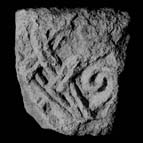
Object type: Fragment, possibly an impost
Measurements: H. 21.5 cm (8.5 in); W. max. 20 cm (8 in); D. 18.5 > 10.5 cm (7.25 > 4.25 in)
Stone type: Very pale orange (10YR 8/2), very shelly limestone. Most shells (bivalves) are elongate and vary from 0.5 to 6.0 mm across; they vary from sub-angular to sub-rounded and are clast supported. A crude alignment can be seen with a hand lens. Ham Hill Stone Member, Bridport Sand Formation, Lias Group, Lower Jurassic
Plate numbers in printed volume: Pls. 309-11
Corpus volume reference: Vol 7 p. 172-3
(There may be more views or larger images available for this item. Click on the thumbnail image to view.)
The block has remains of decoration on two faces. Although too badly damaged to be certain, there was probably a flat band running round the top of the stone on both faces.
A: There is the remains of an irregular roll moulding marking the corner and separating the two faces. Two median-incised crossing strands branch diagonally from right to left from a common base and are interlaced by two other strands. The space between on the right is filled with a deeply incised curled tendril, which is attached to the edge moulding and paired with the tendril on the other face.
B: Two crossing strands of median-incised interlace, and a curling tendril which is 'clipped' to the edge moulding.
C: Recut and mortar covered
D: Hacked back
F: Base smoothly finished
All other sides recut
There are few imposts/capitals surviving from the pre-Conquest period in this area (see also introduction p. 37), but Muchelney was an important site and a royal foundation, and all the elements of the design can be found in pre-Conquest ornament, although I have not been able to find a comparable impost/capital in any other medium. This has all the appearance of a misunderstood copy, possibly from a manuscript source, but must remain an isolated piece at the present time. Foster has compared it with a capital at Milborne Port, Somerset (Foster 1987, 66, 76, no. 46; see Taylor and Taylor 1965, I, 427, fig. 202), and it seems more likely that this piece derives from the church rebuilt in the tenth century than its predecessor which was in existence by the mid eighth (Taylor and Taylor 1965, I, 451–2, 482, figs. 215, 216).
