Select a site alphabetically from the choices shown in the box below. Alternatively, browse sculptural examples using the Forward/Back buttons.
Chapters for this volume, along with copies of original in-text images, are available here.


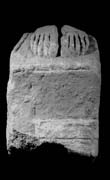
Object type: Fragment of the base of a large-scale rood
Measurements: H. 33 cm (13 in) pediment 21.5 cm (8.5 in) square
Stone type: Yellowish grey (5Y 8/1) shelly oolite. The ooliths, which are mostly in the range 0.4 to 0.6 mm diameter, weather out to give an 'aero-chocolate' texture. Scattered, abraded, bivalve fragments ranging from 0.7 to 3.0 mm across occur; the fragments vary from subrounded and elongate to well-rounded. Bath stone, Chalfield Oolite Formation, Great Oolite Group, Middle Jurassic
Plate numbers in printed volume: Pls. 306-8
Corpus volume reference: Vol 7 p. 171-2
(There may be more views or larger images available for this item. Click on the thumbnail image to view.)
What survives is only the base of a large-scale rood. The block is so carved that the feet are set on a sloping suppedaneum, outlined with a roll moulding, with the face cut back below, and then a projecting columnar feature divided by a double incised line, with red paint surviving within the incisions. The feet, which are all that remain of the figure, are side by side and have long toes carved in high relief, and are about 7 cm wide and 15 cm long.
The scale of what survives indicates that this must once have been a rood of comparable scale to those at Romsey 1, Langford 2 or the much mutilated Headbourne Worthy (Tweddle et al. 1995, ills. 452, 295, 448). These have been fully discussed by Coatsworth (1988, 168–9, 170–1, 173–5) and Tweddle (Tweddle et al. 1995, 28–9, 73–9). When so little survives it is difficult to discuss the type of iconography, and indeed Coatsworth considered that too little survives to be able to determine the type of Christ figure which might be reconstructed (Coatsworth 1979, I, 304), but the fact that the construction seems to be like that of Headbourne Worthy and Romsey 1, and the feet are close together with no intimation of sagging limbs, suggests a comparison with their type (Tweddle et al. 1995, 76). Although this is the 'loin cloth' type (Coatsworth 1988, 163), a similar position of the feet is found also at Langford 2 which is a 'robed' type of Crucifixion (ibid., 163, n. 8). On the basis of comparison with manuscripts and ivories these largescale roods are usually dated to the later Anglo-Saxon period. The distinctive way in which late Saxon homilies and prayers remembered the Crucifixion as constantly related to the Resurrection and the transition from death to life, has been persuasively linked by Raw with the 'symbolic, non-narrative Crucifixion pictures which typify late Anglo-Saxon art' (Raw 1990, 166–7). The careful finish of the stone and the delicacy of carving of what survives does indicate that this figure must once have been of the highest quality.
