Select a site alphabetically from the choices shown in the box below. Alternatively, browse sculptural examples using the Forward/Back buttons.
Chapters for this volume, along with copies of original in-text images, are available here.


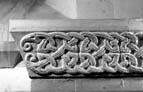
Object type: Panel / door jamb(?)
Measurements: H. 15 cm (6 in); W. 37 > 33 cm (14.5 > 13 in); D. Built in
Stone type: Beneath a thin limewash coating, the stone where chipped is a very pale yellowish grey (10YR 8/1–2) oolite consisting of closely packed, possibly micritised ooliths of 0.2 to 0.3mm diameter, projecting millet seed-like on the stone surface. 'Upper Building Stones' of Chilmark Member, Portland Stone Formation, Portland Group of Vale of Wardour, Upper Jurassic
Plate numbers in printed volume: Pl. 459
Corpus volume reference: Vol 7 p. 419-20
(There may be more views or larger images available for this item. Click on the thumbnail image to view.)
At the end of the pattern are two loose terminals, with two rows of Pattern C loops facing each other. These are arranged in circular curves with straight crossing strands. All of the strands are median-incised.
It is difficult to dissect this piece now that it has been reconstructed in the altar, but it may have been a door jamb originally — certainly it is very unweathered. The interlace pattern was rightly seen by Romilly Allen as related to the turned pattern C knots on two faces of Ramsbury 3 (Allen 1894, 56–8, figs. 7–11; see Ills. 498–502) and there may be some link with that site, but variations of pattern C are quite common in the southwest, as for example at Glastonbury, Somerset (Ills. 224, 232) and Dolton, Devon (Ill. 22). What distinguishes the Knook pattern is the delicacy and elegance of the cutting.
