Select a site alphabetically from the choices shown in the box below. Alternatively, browse sculptural examples using the Forward/Back buttons.
Chapters for this volume, along with copies of original in-text images, are available here.


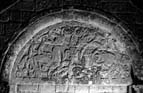
Object type: Tympanum
Measurements:
Stone type: The tympanum is lichen-coated, but is clearly of the same type of stone as the doorway jambs, a loose flake of which is pale greenish-yellow (5Y 7–8/2) calcareous sandstone, sparsely glauconitic, consisting mainly of subangular quartz grains of 0.2mm diameter. Tisbury/Chilmark stone, Tisbury Member, Portland Stone Formation, Portland Group of Vale of Wardour, Upper Jurassic
Plate numbers in printed volume:
Corpus volume reference: Vol 7 p. 240
(There may be more views or larger images available for this item. Click on the thumbnail image to view.)
Appendix B item (stones wrongly associated with pre-Conquest period).
Tympanum over blocked south doorway, with two ribbon-like beasts in an elaborate tree-flower (Ill. 556). Despite attempts to see this as pre-Conquest (Clapham 1930; Taylor and Taylor 1966) the foliage and its ornament are most plausibly Romanesque. But it is of interest that Domesday Book records that Leofgeat/ Leofgyth, who held Knook at the time of the Domesday survey, 'made and makes the King's and Queen's gold fringe' (Thorn 1979, ch. 67, sect. 86) — thus performing the same service at both the Anglo-Saxon and Norman courts (Dodwell 1982, 75, 78, 227). Since there can be a close resemblance in the motifs to be found on both embroidery and sculpture (see the Cuthbert stole and maniple, Ills. 535–8), the same inspiration from late Saxon art may have been transmitted here by the continued use of resident craftsmen.
