Select a site alphabetically from the choices shown in the box below. Alternatively, browse sculptural examples using the Forward/Back buttons.
Chapters for this volume, along with copies of original in-text images, are available here.


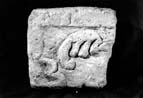
Object type: Corner fragment of a slab
Measurements: H. max. 24 cm (9.5 in); W. 26 cm (10.25 in); D. 13 cm (5 in)
Stone type: As Keynsham 10, but ooliths range not so large (up to 0.9 mm diameter), but more shelly with some fragments up to 14 mm across. Shell fragments vary from sub-angular and platy to well-rounded. Bath stone, Chalfield Oolite Formation, Great Oolite Group, Middle Jurassic
Plate numbers in printed volume: Pls. 299-301
Corpus volume reference: Vol 7 p. 168
(There may be more views or larger images available for this item. Click on the thumbnail image to view.)
A (broad): There is only one carved face. A wide flat frame encloses a bold deeply cut curling palmette frond, with two rounded pellets or buds adjacent.
B (narrow) and F (bottom): Broken away
C (broad): Plain, traces of red colouring
D (narrow): Plain but smoothly dressed, traces of red colouring
E (top): Plain and smoothly dressed
This is the corner of a slab, possibly a grave-cover, and like Keynsham 9, 10 and 12 these could have been the covers for graves inside a church or porticus. These were probably high status graves since the commonest type of grave-cover in this period simply bears a cross. These pieces with delicate plant ornament are an indication of the importance of the site, which had been a royal possession (Costen 1992a, 174). The traces of a thin granular covering of crushed brick and sand is noteworthy on all faces. The rather random placing of the lobed frond and the pellets against an empty background is again reminiscent of later ninth-/early tenth-century metalwork.
