Select a site alphabetically from the choices shown in the box below. Alternatively, browse sculptural examples using the Forward/Back buttons.
Chapters for this volume, along with copies of original in-text images, are available here.


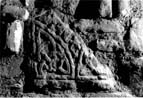
Object type: Corner fragment of a slab
Measurements: H. 35 cm (13.5 in); W. 40 cm (15.5 in); D. Built in
Stone type: Where revealed beneath soot coating, a pale yellowish grey (10YR 8/2) oolitic limestone with a calcite matrix. Ooliths of around 0.4mm diameter (range 0.3 to 0.6mm) shown by their empty sockets, together with some thin worn 2mm shell fragments. Bath stone
Plate numbers in printed volume: Pl. 302
Corpus volume reference: Vol 7 p. 169
(There may be more views or larger images available for this item. Click on the thumbnail image to view.)
A (broad): Only one face is visible. Corner fragment of a slab, outlined by a flat-band moulding. In the angle is a complete sub-triangular field outlined by a fine roll moulding which encloses a complex knot with pointed terminals and median-incised strands. Opposing it is the vestige of a similar triangular field with traces of interlace. The space between these fields is filled with a worn foliate design which appears to contain a pointedand-lobed leaf and a leaf-flower (Cramp 1991, fig. 12d).
Although this is the same formula as Keynsham 8, 9 and 10, it does not necessarily belong to any of those monuments, and may have been part of a decorative wall panel. The interlaced knot with median-incised strands and the bell-like leaf-flower are reminiscent of East Stour (Ills. 57–64) and manuscript art of the ninth/tenth century.
