Select a site alphabetically from the choices shown in the box below. Alternatively, browse sculptural examples using the Forward/Back buttons.
Chapters for this volume, along with copies of original in-text images, are available here.


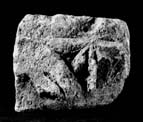
Object type: Fragment of a slab
Measurements: H. max. 10 cm (3.75 in); W. 11.5 cm (4.5 in); D. 10.2 cm (4 in)
Stone type: Medium-grained, matrix-supported oolite with ooliths weathering out to give 'aero-chocolate' texture. Ooliths 0.3 to 1.5 mm diameter, but mostly in the range 0.4 to 0.6 mm; a few scattered shell fragments up to 2.5 mm across. Bath stone, Chalfield Oolite Formation, Great Oolite Group, Middle Jurassic
Plate numbers in printed volume: Pl. 298
Corpus volume reference: Vol 7 p. 168
(There may be more views or larger images available for this item. Click on the thumbnail image to view.)
Only one face has any discernible carving and here the ground between the relief carving is finely polished and in places covered in crushed red brick.
A (broad): Traces of the flat-band moulding survive, and pendant from it is a five-petalled half flower with a long central petal filling the space between a curving frame on the left and what was possibly another curving frame on the right.
B and D (narrow): Broken
C (broad): Possibly some of original surface remains.
E (top): Part of some original surface remains.
The carving on this piece is notably fine and delicate, and the banding and floral ornament is at a smaller scale than Keynsham 9, although the design is similar and it must be of a similar date. Again parallels can be drawn with the Beeston Tor brooch (Webster and Backhouse 1991, ill. 245b) and the East Stour cross (Ill. 64). The red colouring in the interstices of the relief is noteworthy and it seems a feature of the Keynsham carvings that the colouring was achieved with crushed brick.
