Select a site alphabetically from the choices shown in the box below. Alternatively, browse sculptural examples using the Forward/Back buttons.
Chapters for this volume, along with copies of original in-text images, are available here.


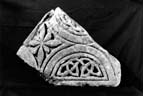
Object type: Corner fragment of slab, possibly grave-cover
Measurements: H. 41 cm (16 in); W. 26 cm (10.25 in); D. 15 cm (6 in)
Stone type: Grey-weathered and lichen-covered oolitic limestone, having a calcite matrix pitted by the sockets of ooliths of around 0.4mm diameter and including a few shell fragments and one 5-mm polyzoan fragment. Some calcite veinlets. Bath stone
Plate numbers in printed volume: Pls. 295-7
Corpus volume reference: Vol 7 p. 167-8
(There may be more views or larger images available for this item. Click on the thumbnail image to view.)
One face only is carved, the surviving sides and back are plain but smoothly finished. This broad face is edged with a flat-band moulding and the designs are cut in deep relief. One complete semi-circular field is outlined by broad and narrow mouldings and contains two linked pattern E knots; the beginning of an opposed semi-circular field probably contained a similar design. The spandrel between these and a plain semi-circular area below is a flower enclosed in a quadrilateral concave frame. Its eight deeply cut and pointed petals are arranged to fill the space. All the other sides are broken away.
This is an elegantly carved and well designed piece and although it is most plausibly a grave-cover it is just possible that it is a decorative wall panel. The division of surfaces into small decorative subdivisions by curving frames is popular in ninth-century metalwork: see for example the Beeston Tor disc brooch (Webster and Backhouse 1991, 269, ill. 245b) or for the flower type the tiny silver panels on the Gilling Beck sword (ibid., 277, ill. 251). Although similar arrangements of panels of interlace and plant forms occur in manuscripts (see for the pointed flower, the Marmoutier Sacramentary, fol. 173v (Hubert et al. 1970, ill. 119), or BL Royal 1. E. VI, fol. 4r (Wilson 1984, ill. 103)), the link with Anglo-Saxon metalwork seems much closer. In sculpture, face B of the East Stour shaft from Dorset has very similar floral terminals on its bush-scroll (Ill. 64).
