Select a site alphabetically from the choices shown in the box below. Alternatively, browse sculptural examples using the Forward/Back buttons.
Chapters for this volume, along with copies of original in-text images, are available here.


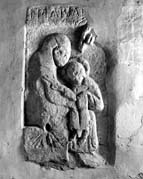
Object type: Panel with inscription
Measurements: H. 109 cm (43 in); W. 56 < 60 cm (22 < 24 in); D. Built in
Stone type: Pale brownish yellow (10YR 8/3–4) unevenly graded oolitic limestone comprising, within a calcite matrix, ooliths of around 0.5mm diameter (mostly 0.4 to 0.6mm) represented by vacated sockets, numerous pellets (0.9 to 1.0mm) and rolled shell fragments, also larger (5mm) thin shell fragments; no calcite veins. There is no obvious bedding on the one surface of the stone that is exposed, but the oolite of the central column (early thirteenth century) of the south nave arcade is of similar texture to the Anglo-Saxon slab and also displays the cross-bedding and 'bars' typical of Taynton stone. Taynton stone, Taynton Limestone Formation, Great Oolite Group, Middle Jurassic of Taynton, Oxfordshire
Plate numbers in printed volume: Pls. 453-4
Corpus volume reference: Vol 7 p. 217-9
(There may be more views or larger images available for this item. Click on the thumbnail image to view.)
This seems to be the left side of a panel in which the background has been carved back at an angle, leaving the central figures in high relief, in places as much as 7.5 cm. The inscription is on a band at the top, and there are traces of the incised cloud or sphere from which the Hand of God emerges in blessing. The first two fingers of the hand point to the Child and the thumb is bent towards the last two fingers in a naturalistic way. Mary is seated sideways, her head half turned towards the viewer. Her right arm extends across the waist of the Child, who is seated across her knees facing the viewer but with his head inclined towards Mary. His head is haloed, his right hand has the two first fingers prominently extended in blessing and he is holding a book in his left hand. He wears a long-sleeved garment which extends to his ankles, and his feet are bare.
Inscription An incised inscription (Okasha 1971, 82) runs across the horizontal raised band at the top of the panel. It is now incomplete and an uncertain number of letters has been lost from the end of the inscription after the break in the stone. The letters are neatly laid out but their feet are set gradually higher as the inscription moves towards the right, in order to take account of the pair of incised lines from which the Hand of God emerges. There is a corresponding reduction in the height of the letters (the first M is 6.5 cm high, whilst the second A is 5.5 cm high and the following incomplete letter was smaller still).
[+]M[AR]IA[D] —
The text now reads: + MARIA [D...] — ('+ Mary —.). The text opens with a clear but damaged initial cross in the form of a Latin cross. The letters are capitals and the following features deserve comment. The As have horizontal head-bars and broken cross-bars. The M has vertical first and last strokes and the base of the central 'V' is set well above the base-line. The bow of the R is open. These are all common variants of the 'Roman' capital forms in Anglo-Saxon inscriptions (Okasha 1964–8, table 1 a). The A, however, is less common in the later Anglo-Saxon period and seems either not to occur or to be very rare in display script of this time (illustrations in Temple 1976). The most probable reading of the fragmentary final letter is D, in which case it followed the form of the 'Roman' capital.
The detail of the letters has suffered from weathering and wear but they were neatly cut with a V-shaped profile and there are worn traces of serifing at ends of strokes. There also appears to have been a form of serif-like decoration below the angle of the central 'V' of the M. There are indications of a similarly placed pendant serif on the M on face B of the Barton St David plaque (p. 137, Ill. 165). There are less certain indications of similar hanging serifs below the angles of the cross-bars of the As.
Inscription The inscription is now incomplete but it seems to have served simply to identify one or more of the figures or of the scene. The word MARIA is set directly over Mary's head and may have been intended as a one-word label comparable to the MARIA identifying the Virgin in the scene of the Ascension in the Athelstan Psalter (BL Cotton Galba A. XVIII, fol. 120v: Temple 1976, no. 5, ill. 31). In that case the word that apparently began with a D would perhaps have referred to the Hand of God or to the Christ Child. Alternatively MARIA [D...] may have formed a short phrase. There would be room for three or so letters after the D if the raised band continued as far as the present right-hand edge of the stone. Simple identificatory inscriptions, of the sort this appears to have been, were not uncommon in later Anglo-Saxon art (Gameson 1995, 90–1). The inscribed raised band across the top of an ivory plaque of the Last Judgement found at North Elmham provides an approximately contemporary formal parallel (Okasha 1971, pl. 97; Gameson 1995, pl. 20b). The forms of the capitals can be matched in both early and later Anglo-Saxon inscriptions and so cannot be used to date the sculpture.
This particular pose of the Virgin and Child, in which the two figures face in opposite directions but the head and the upper part of the Virgin's body is turned to the viewer and the head of the Child is inclined towards his mother, suggest that this piece is related to the informal tradition of representation. This is found in Anglo-Saxon England as early as on the Cuthbert coffin and in the Book of Kells (Kitzinger 1956, 248–64, pl. IV, fig. 4a and pl. XIV, fig. 1) but is rare elsewhere, and indeed Raw has cited these two early depictions of the late seventh and eighth centuries as analogies for Inglesham (Raw 1966, 46). There are however significant differences: at Inglesham the Virgin's head is veiled but without a halo, whilst the divinity of the Child is stressed by the way in which his hand held in blessing is like that of the Father, and in his mature role he holds a book in his hand. In early Christian art the Child normally holds a scroll, and this image recurs throughout the Middle Ages in East Christian depictions (e.g. Schiller 1980, ills. 411, 414, 427, 432), although it is possible that another model in which a book was held existed in Rome, as the indistinct paintings in St Maria Antiqua (sixth century) or an icon of the eighth century indicate (Schiller 1980, ills. 438 and 440). It is also noteworthy that at Langridge, Somerset (Ill. 305), the Child is also depicted with his right hand held up in blessing and his left supporting a book. The hand of the Child held up in blessing is a feature of some of the earliest depictions of the scene, as for example on a sixth-century ivory diptych from Constantinople (ibid., ill. 411). This seems to emphasise that from the beginning he was born divine, as ælfric noted in his homily for the Feast of the Nativity: 'He was born today from the holy maiden Mary with body and soul, he who was always living with the Father in his divine nature... He was always born from the Father because he is the Wisdom of the Father through whom he wrought and shaped all created things' (Godden 1979, 3).
From the sixth century onwards it is rare for Mary to be depicted without a halo; in fact in Anglo-Saxon carvings this and Langridge (Ill. 305) are the only places where she is not haloed (cf. Dewsbury or Deerhurst: Hawkes 1997, fig. 7; Bailey 2005, pl. 4), and even in the vestigial depiction on the Franks casket (Beckwith 1972, 14, ill. 4) both figures are haloed, with the usual distinction that Christ's halo bears a cross and Mary's is plain. This lack of a halo on the Inglesham carving is all the more surprising in view of her importance in the later Anglo-Saxon church. Mary was a crucial figure in the devotions of the Benedictine reforms, and as Clayton has shown, 'Mary was effectively the patron saint of the reform movement' (1994, 98); but 'although the Marian dedication is to be found in almost every newlyestablished reformed house, evidence for particular devotion to Mary is lacking for most of them and is instead connected almost exclusively with Winchester and reformed houses which were closely linked to Winchester' (ibid.). It is possible then that the iconography of this piece was derived from that centre.
This carving has been seen as crude local work, but the peculiar lack of drapery folds on the figures — particularly the Virgin — need not be seen as an indication of rusticity, but, as at Deerhurst (Rice 1952, 107, pl. 18a), an indication that the drapery (and even a halo) on the figure would have been painted, and the sunken eyes filled with paste or glass. In that case this large-scale carving would have been an impressive element in the church. Moreover if one considers Higgitt's point (above) that the D could have been the first letter of another word, then the piece would have been even larger.
